Is Subcision Ineffective? A Thorough Explanation of Why It Fails and the Keys to Success

Language:
Language:



BLOG

When researching treatments for acne-scar depressions, you may come across phrases such as “subcision failure” and “subcision no results.” However, when the details are examined, cases that can truly be called failures of the procedure itself are limited. Most come down to one of four factors: the acne-scar type was not suited to the indication, the number of treatments was insufficient, the needle selected was not appropriate for the case, or no measures were taken to prevent re-adhesion.
This article explains examples of subcision failure and its risks, organizes the four reasons why treatment may feel ineffective, and outlines how to choose a clinic that can help prevent unsatisfactory results.









Subcision is a treatment in which a specialized medical needle is inserted beneath the skin without making an incision to release hardened fibrous tissue. It is also called a subcutaneous non-incisional procedure.
Since it was first reported in 1995, its efficacy has been confirmed in multiple clinical studies overseas. It may produce changes even in crater scars that did not respond to laser or Derma Pen.
The needle used for subcision to separate tissue beneath the skin is an unapproved medical device under Japan’s Pharmaceuticals and Medical Devices Act. The needles used at LIVELY CLINIC are imported for individual use under the responsibility and management of physicians and have not received domestic regulatory approval.
If health damage occurs as a result of treatment using an unapproved medical device, it is not covered by Japan’s relief system for adverse drug reactions and other health damage. For information on the risks of individually imported medicines and other products, please refer to the Ministry of Health, Labour and Welfare’s “Medicines and Other Products Requiring Attention When Importing for Personal Use.”

Depressed acne scars can be broadly divided into the following three types.
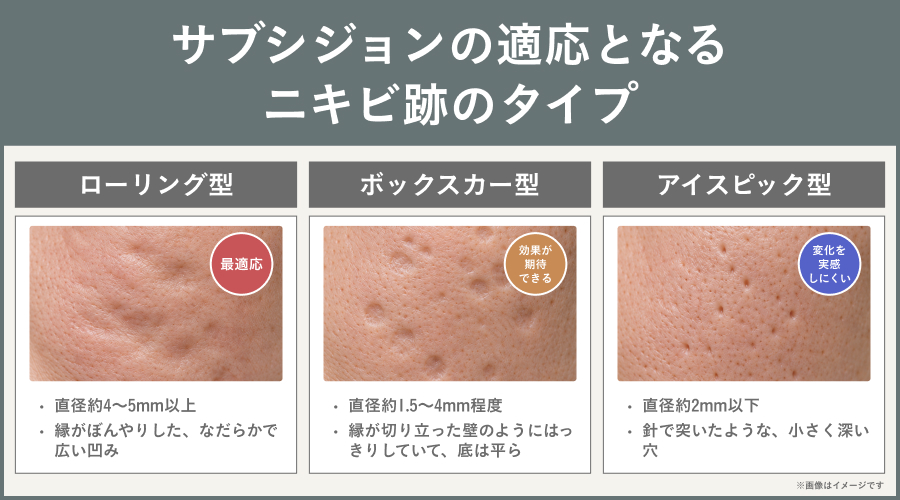
Among these, rolling scars respond best. They are gently depressed scars measuring 4–5 mm or more in diameter, in which the dermis is adhered to the fascia. Boxcar scars approximately 1.5–4 mm in diameter may also be expected to show some improvement, and when multiple depressions are clustered together, the entire area can be supported from below.
By contrast, ice pick scars measuring 2 mm or less in diameter and extending deeper than the dermis are classified as a type in which it is difficult to notice change with subcision alone.
In areas where acne has repeatedly occurred, fibrosis causes the tissue beneath the dermis to harden. The hardened fibers connect the dermis and fascia, pulling the skin inward and appearing as a depression on the surface.
Surface treatments such as laser and Derma Pen act only vertically on the skin, making it difficult to sever the fibers connecting the dermis and fascia. In contrast, subcision can advance the needle diagonally and horizontally, allowing it to target the fibers themselves.
If the fibers are merely released, the skin and fascia may adhere to each other again. This phenomenon is called re-adhesion.
For this reason, a method has been widely used in which hyaluronic acid is injected into the separated layer to lift the depression from within while maintaining the space. The injected hyaluronic acid is absorbed in approximately six months, but the body produces its own tissue and replaces it during that time, so the effect does not disappear completely after absorption. A method using threads to provide support may also be selected.
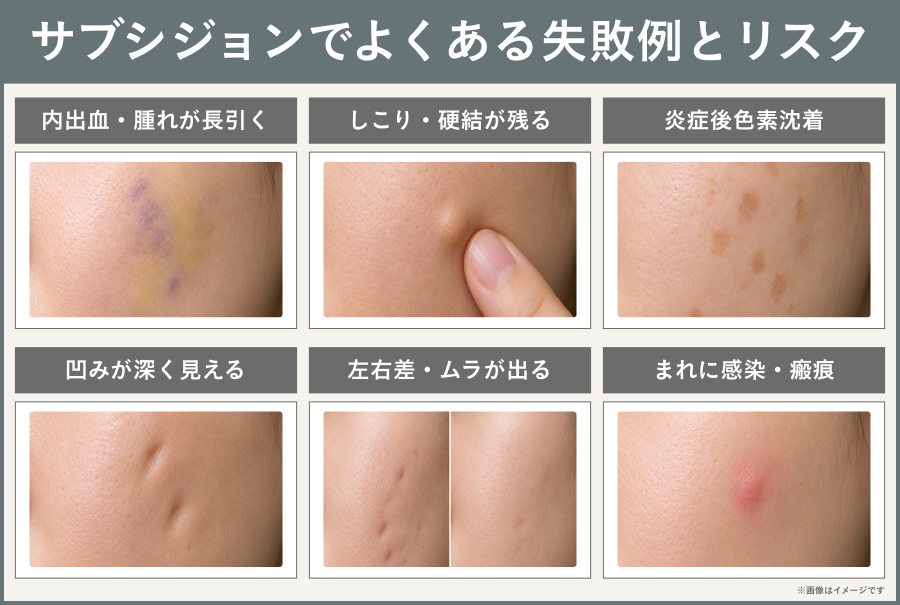
Symptoms described as failures can be divided into those that are simply part of the recovery process and actual complications. These include the following.
Let us look at each in detail.
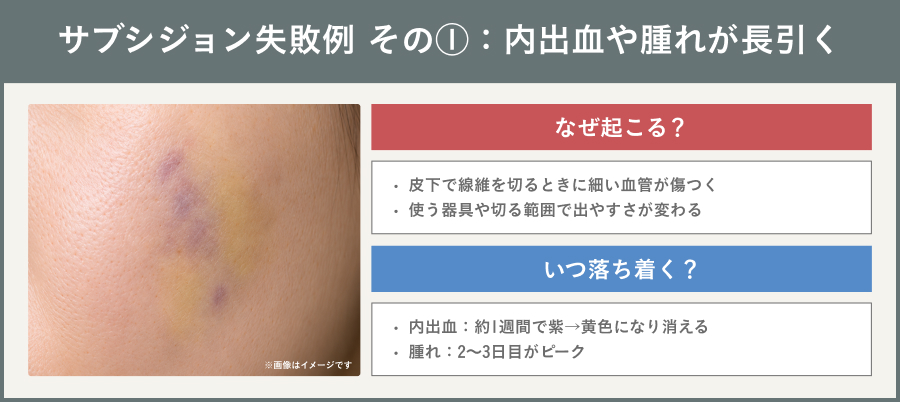
Because subcision releases fibers beneath the skin, small blood vessels may be injured, potentially causing bruising and swelling. The incidence varies depending on the instruments used and the area released. When a blunt-ended cannula is used, bleeding tends to be reduced.
Bruising usually fades over approximately one week, changing in color from purple to yellow. Swelling generally peaks on days 2–3 after treatment and settles over 1–2 weeks.
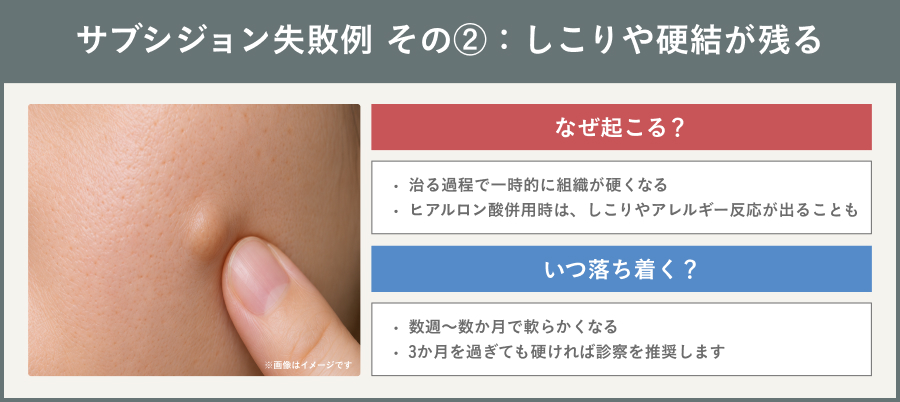
After treatment, you may feel a hard lump when touching the area. In many cases, this is temporary fibrosis that occurs during the healing process and gradually softens over several weeks to several months.
However, if hardness remains after three months, please undergo an examination, as it may be becoming established as scar tissue. When hyaluronic acid is used in combination, lumps or delayed allergic reactions may appear several months to six months later.
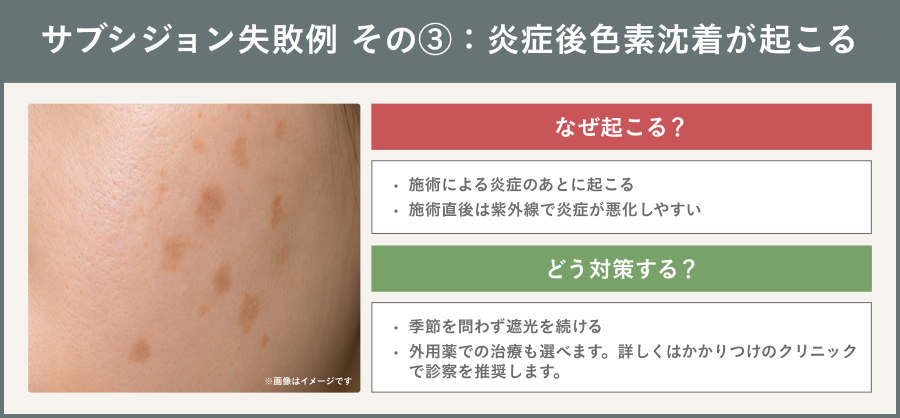
Brown pigmentation may occur after inflammation caused by the treatment. This reaction is relatively common in Asian skin, including Japanese skin.
The skin barrier is weakened immediately after treatment, and exposure to ultraviolet rays can worsen inflammation. Because recently sunburned skin is also a contraindication to treatment, continue protecting the area from light regardless of the season. If pigmentation has already developed, oral tranexamic acid or vitamin C and topical medication may be considered as treatment options.
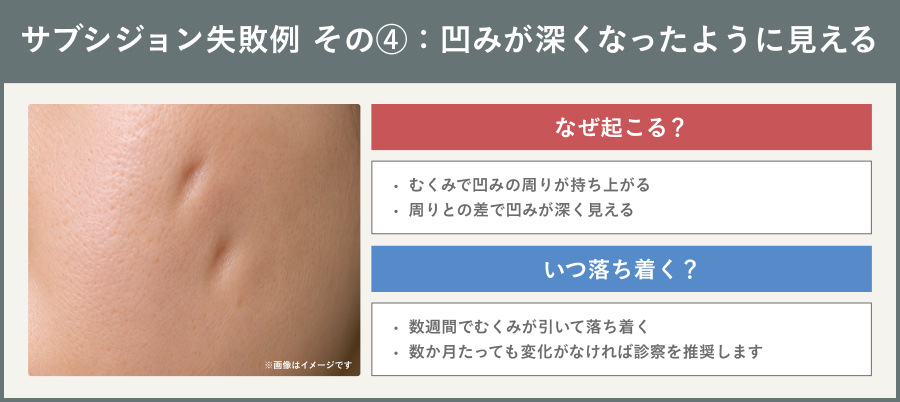
Immediately after treatment and for several weeks afterward, swelling may lift the area around the depression, making the depression appear relatively more pronounced. This is a period when it is easy to feel that the condition has worsened, but it generally settles within several weeks.
If you judge the result by looking in the mirror during this period, you may be inclined to conclude that the treatment was ineffective. Taking a pre-treatment photo under the same lighting can help you compare the area after the swelling subsides. If no change is seen after several months, consult your clinic, including about the possibility that the area released was insufficient.
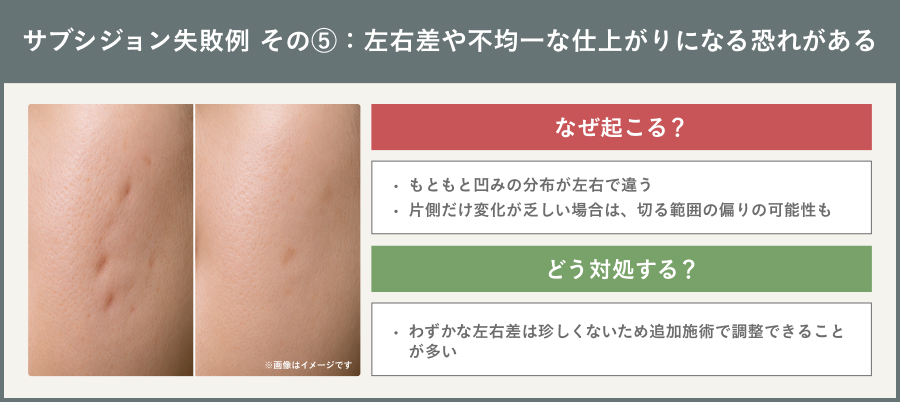
If the distribution of depressions originally differs between the left and right sides, the degree of improvement will also differ. Because the human face is not perfectly symmetrical to begin with, slight asymmetry remaining after treatment is not unusual.
However, if one side clearly shows less change, unevenness in the area released may also be a possibility. In many cases, this can be adjusted with additional treatment, so please communicate your concerns openly at your next examination.
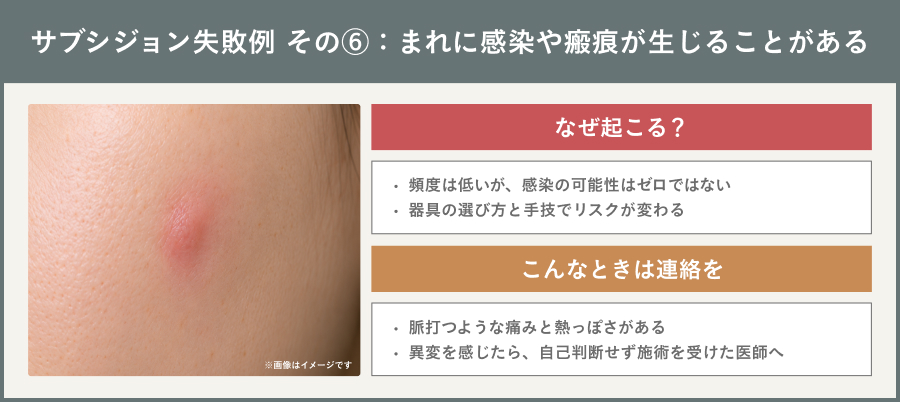
Although it is not common, infection at the treatment site is possible. If you experience pulsating pain accompanied by a sensation of heat, contact the clinic where you received treatment as soon as possible.
In addition, there have been reports of new scars forming during treatment using sharp, pointed needles. The degree of risk varies depending on the instruments selected and the technique used. If you notice anything unusual, do not make your own judgment; consult the doctor who performed the treatment.
After reviewing examples of failures in terms of symptoms, let us look at where dissatisfaction with the results may come from. The causes can broadly be organized into the following four categories.
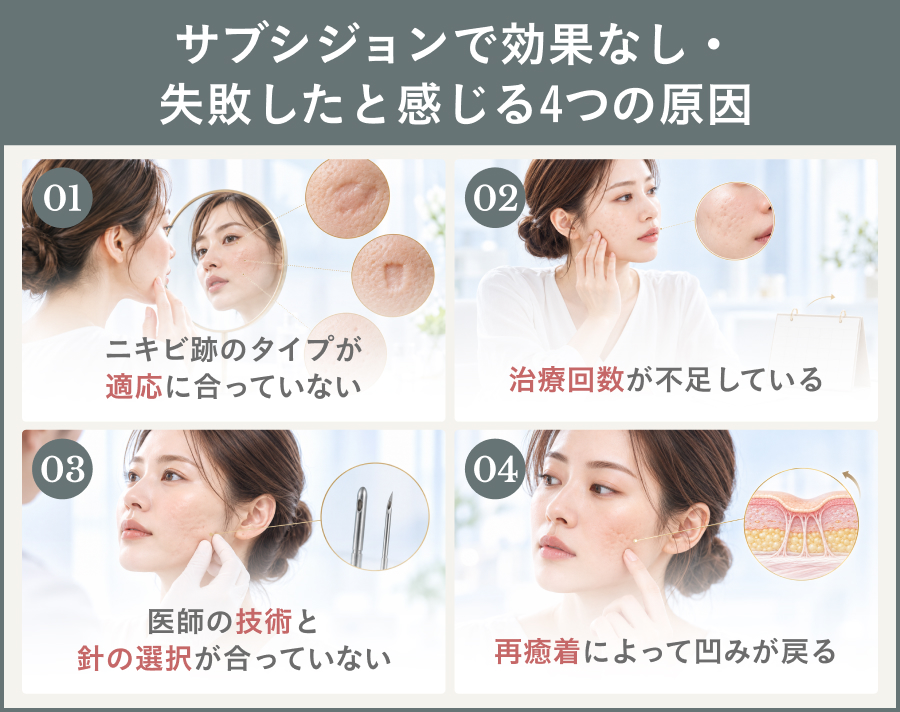
Let us explain in detail.
This is the most common cause. In cases consisting mainly of depressions caused by atrophy of the subcutaneous fat or shallow unevenness at the epidermal level, releasing the fibers will not lift the depression.
The key point is whether there are adhesions caused by subcutaneous fibers. If the depression becomes shallower when the surrounding skin is gently stretched sideways with your fingers, adhesions are likely to be involved.
In reality, multiple types usually coexist across the cheek as a whole. Because only depressions caused by adhesions improve, other types may remain and the overall impression may not change.
Some people notice a change after one treatment, but adhesions form in layers over a long period, and some reports indicate that it is difficult to release all of them in a single treatment. Deep crater scars or extensive cases generally require multiple treatments.
During the consultation, confirm how many treatments the proposed plan anticipates. More treatments are not necessarily better; an important basis for judgment is whether the doctor can explain the reason for recommending that number.
Two types of needles are used for subcision: pointed needles and blunt-ended cannulas.
A blunt-ended cannula can separate a wide area in a fan-shaped pattern from a single entry point. Because it advances while moving blood vessels aside, it is less likely to cause bruising and is suited to cases in which depressions are scattered across a wide area. Pointed needles, on the other hand, are effective for precisely severing hard adhesions in a limited area.
Rather than one being superior, the appropriate needle depends on the width and hardness of the depression. If this assessment is inaccurate, adhesions may remain even though the area appears to have been treated.
Re-adhesion is often behind the complaint that the area improved once but then returned.
Once separated, the skin and fascia remain facing each other and in contact if left untreated. If the surfaces adhere again during the healing process, the lifted depression is pulled inward once more. The feeling that the area has returned to its original state over several months is often due to this process.
A common way to prevent this is to place hyaluronic acid in the gap created by releasing the adhesion. Keeping the surfaces physically separated prevents them from adhering again. Whether treatment ends with release alone can determine how the area appears six months later.
A considerable proportion of the concerns described as dissatisfaction do not constitute treatment failure. Distinguishing these cases can help prevent you from becoming unnecessarily anxious after treatment. Let us look at two typical patterns.
As mentioned earlier, bruising and swelling are expected reactions that occur with a certain frequency. What determines how they are perceived is whether you were informed of this possibility beforehand.
Even when looking at the same purple mark, someone who was informed may accept it as part of the recovery process, while someone who was not informed may regard it as a failure. How carefully the clinic explains downtime during the consultation is one criterion for assessing a clinic.
The mechanism by which subcision lifts a depression has two stages. There is an immediate change when the adhesion is released, followed by a gradual change as new collagen forms in the released space and supports the area from below. The latter requires several months.
In addition, around one month after treatment, swelling and mild inflammation may remain, making the skin look different from usual. This is not an ideal time to judge the results. It is also often overlooked that insufficient sun protection or moisturizing can delay recovery and make it more difficult to see results.
If you undergo treatment without knowing when changes will appear, you may mistake an interim result for the final outcome. First, understand how long it may take to feel the effects and the estimated number of treatments needed.
Some lifting caused by the release of adhesions occurs immediately after treatment. However, bruising and swelling overlap with this change, so the appearance at this stage is not a reliable basis for evaluation.
Clear changes are generally considered to begin becoming noticeable around 1–3 months later. Some people feel improvement 2–3 weeks after the swelling subsides, while others see changes gradually over 3–6 months. The timeframe varies depending on the depth of the depressions and age.
For deep crater scars or extensive areas, multiple treatments are generally required. Many clinics give around three treatments at one-month intervals as a guideline.
It is important to understand the purpose of the interval between visits. Waiting one month is not due to appointment availability; it allows time for new collagen to form in the released area. Shortening the interval means treating tissue that has not yet completed its remodeling process, and does not improve efficiency.
When a three-treatment course is planned, three months after the final treatment is a preliminary evaluation point. Many clinics schedule confirmation of the final result 3–6 months later, so you should be prepared to monitor the progress for at least six months from the first treatment.
If you have a wedding or major event coming up, a suitable time to begin is approximately six to eight months before the event. If treatments are packed in too close to the date, you may reach the event while bruising remains.
It is difficult for patients to directly assess the quality of a doctor’s technique. However, the way the doctor answers your questions can indicate how thoroughly the treatment plan has been designed. Here are four points to confirm during your consultation.
Let us explain each point in detail.
Ask what type of depression you have and how much the types overlap. Whether the answer includes an explanation of what the treatment can and cannot address can help prevent a mismatch in expectations.
The same perspective is useful when viewing before-and-after photos. Dramatic improvement is often seen in cases with a high proportion of rolling scars, so comparing the conditions with your own skin can make it easier to imagine a realistic outcome.
Ask which layer they plan to release with which needle. A doctor who can explain the reason for using different instruments is more likely to be making case-by-case decisions.
If the explanation recommends only one option without discussing the conditions, it is worth asking further questions. LIVELY CLINIC states on its official website that it changes the needle used according to the treatment area and skin condition.
Ask whether the doctor recommends combining hyaluronic acid or threads and, if not, whether they can explain the reason. This is directly related to satisfaction six months after treatment.
If the explanation ends with releasing the adhesions alone, ask how the risk of re-adhesion is being assessed. Depending on the depth of the depression, deciding not to combine another treatment may be appropriate. Because this may involve additional costs, make your decision only after understanding both the necessity and the expense.
The cost of subcision varies considerably by clinic. Prices generally center around approximately 10,000 yen per 1 cm × 1 cm, ranging from under 10,000 yen to nearly 30,000 yen.
The existence of additional costs is easy to overlook. If local anesthetic, cannula needles, combined hyaluronic acid, or oral and topical medications after treatment are charged separately, the actual amount paid may differ substantially from the quoted price. If you are treating an extensive area, it is also reassuring to check whether the clinic has a maximum fee.
When looking into stories of unsuccessful acne-scar treatment, some cases appear to have been caused not by the choice of treatment itself but by how treatments were combined.
Derma Pen and Derma Roller are treatments that use fine needles to create microscopic openings in the skin and promote regeneration from the epidermis to the superficial dermis. The depth at which they act is entirely different from that of subcision. Many reports that Derma Roller was ineffective are the result of repeatedly treating the surface when the depression was caused by deep adhesions.
Ideally, the deep adhesions should be released first, followed by treatment of the surface. Even if the surface is regenerated while the adhesions remain, the pulled-in depression may return to its original state.
Subcision is well worth considering for people with depressions pulled inward by adhesions. A typical example is predominantly rolling scars with wide openings that become shallower when the skin is stretched with the fingers.
People who have not seen satisfactory results despite repeated fractional laser or Derma Pen treatments may also be candidates. If the cause of the depression lies beneath the skin, repeated approaches from the surface cannot reach it.
Crater scars on the temples, cheeks, and facial contours are considered areas that tend to respond well. Even scars from chickenpox or trauma may be expected to improve on the same principle if they are caused by subcutaneous adhesions.
Acne scars consisting mainly of redness or pigmentation without unevenness or depressions are not indications for subcision. Depressions caused by atrophy of the subcutaneous fat are also not indications; other treatments suited to each condition are available.
The following conditions are contraindications.
In addition, whether treatment is possible may change depending on underlying conditions and medications being taken. As judgments may also differ between clinics, disclose your complete medical history and medication details during your examination.
The results of subcision are influenced more by the decisions made beforehand than by the procedure itself. The decisive factors are whether the fibers pulling the depression inward have been accurately identified, whether the needle suited to the case has been selected, and whether measures have been prepared to prevent re-adhesion. When these three points are properly addressed, many situations described as failures can be avoided.
At LIVELY CLINIC, we select needles according to the treatment area and skin condition and use a treatment plan designed to prevent re-adhesion by combining hyaluronic acid. Begin by confirming the type of depression you have during a consultation.
※For treatments other than the full-face treatment, a separate local anesthesia fee of 22,000 yen will be charged.
※Anesthetic cream (optional): ¥3,300
※Nitrous oxide anesthesia (optional): ¥8,800
※Sedation Pack / 3,300JPY
※Acne and comedone extraction / 3,300 JPY (1 area)