


How ADVATx-LASER Affects Sebum: Explained with Case Examples|How It Improves Enlarged Pores and Shine

Language:
Language:



BLOG

“Even if laser treatment is effective, I can’t bring myself to try it because of the downtime.” This is a concern we hear often. Many people feel that spending several days with redness or swelling is not realistic when fitting clinic visits around work or childcare.
ADVATx-LASER is designed to address these concerns, and in most cases, makeup can be applied from the day of treatment. At the same time, the phrase “almost no downtime” can easily be taken out of context, and is not always understood accurately. There is solid technical reasoning behind why the downtime is limited.
In this article, we explain everything carefully, from how the treatment works to post-treatment care and precautions.




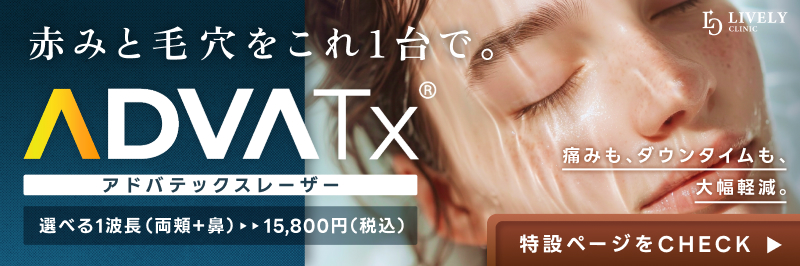




ADVATx-LASER is a fractional laser equipped with two wavelengths, 589nm and 1319nm. It is characterized by its ability to address a wide range of skin concerns, from facial redness and inflammatory acne to visible pores, sebum-related concerns, and improved skin firmness through the promotion of collagen production.
It has received FDA (U.S. Food and Drug Administration) approval for 25 diseases and conditions, and its efficacy and safety as a medical device have been internationally recognized. In Japan, its applications are also expanding for conditions that have been difficult to address with conventional treatments, including rosacea, acne scars with residual redness, and enlarged pores, and it is becoming established as an option in cosmetic dermatology.
A feature of ADVATx-LASER is its flexibility not only in wavelength selection but also in the “irradiation method.” With standard irradiation, either 589nm or 1319nm is delivered evenly across the entire face, with the goal of improving overall redness and skin quality.
For areas with particularly strong redness, such as part of the cheeks or around the nose, 589nm may instead be delivered in spots at a somewhat higher output. In this case, redness or mild swelling may occur in the treated areas for approximately 2–3 days, and the expected downtime may be longer than with standard uniform irradiation.
If you undergo treatment based only on the understanding that it is a “treatment with limited downtime,” you may feel a gap when this irradiation method is selected. It is therefore important to confirm the treatment plan thoroughly during your consultation. Details are explained in the following article.
To understand ADVATx-LASER correctly, it is important to know what each of its two wavelengths acts on. Different wavelengths target different tissues and produce different effects. We explain each one in detail.

The 589nm wavelength is selectively absorbed by two substances: hemoglobin and porphyrin. By acting on hemoglobin, it concentrates energy on dilated capillaries, causing them to contract and become occluded. This makes it effective for improving chronic facial redness, rosacea, and telangiectasia.
Porphyrin, meanwhile, is a substance produced by Cutibacterium acnes, the bacteria that contribute to acne. When exposed to 589nm light, porphyrin is excited and generates reactive oxygen species, directly damaging the acne-causing bacteria. This wavelength can approach inflammatory acne that may be difficult to address with antibiotics or topical medications through a physical method using laser treatment. Because it can improve redness and suppress inflammation at the same time with one wavelength, treatment efficiency is increased.
The 1319nm wavelength is readily absorbed by water in the skin, delivering thermal energy to the dermis. This thermal stimulation activates fibroblasts and promotes collagen production, contributing to reduced pore visibility, improved firmness and elasticity, and an approach to fine lines. It also provides thermal damage to the sebaceous glands and helps suppress excessive sebum production, making it effective for people troubled by shine or recurring acne.
Topical sebum-care products act only on the skin’s surface, whereas ADVATx-LASER approaches the sebaceous glands themselves by delivering heat to the dermal level. This action at the source is why it is considered effective for chronic skin problems that are difficult to improve with temporary care alone.
Why is the downtime so limited while combining two wavelengths? The output is not simply reduced; the irradiation technique itself incorporates specific innovations.
Temporary redness or a sensation of heat may occur immediately after treatment, but in many cases these settle within a few hours. Mild swelling usually subsides by the following day, while some people experience a feeling of dryness for approximately 1–3 days. Blisters, significant swelling, or scabbing are rare, and downtime severe enough to interfere with daily life has hardly been reported.
However, the intensity of the response varies depending on the treatment output, treatment area, and individual skin type. Since it is particularly difficult to predict the skin’s response after the first treatment, it is reassuring to avoid scheduling treatment immediately before an important appointment or to leave plenty of flexibility in your schedule the following day.
The limited downtime of ADVATx-LASER is achieved by combining two techniques: “soft pulsing” and “fractional irradiation.”
Conventional lasers deliver a short pulse of light to the skin all at once. Because energy is concentrated instantaneously, treatment effects can be strong, but surrounding healthy tissue is also more likely to be damaged, which can lead to downtime.
Soft pulsing is a technique that divides the energy delivered in one treatment into multiple fine pulses before delivering it to the skin. The total amount of energy remains unchanged, while the thermal burden on the tissue is distributed over time.
This technique balances the conflicting goals of “maintaining treatment effects while minimizing skin damage” and is the key feature supporting ADVATx-LASER’s limited downtime.
Fractional irradiation is a method in which the laser is delivered in small spots at regular intervals rather than uniformly across the entire skin surface. Because the healthy tissue that was not irradiated remains intact, the skin can repair itself much more quickly.
In addition, the surrounding healthy tissue helps repair the thermal damage caused by the laser, so this method has less downtime than full-surface irradiation and is easier to repeat at regular intervals. By combining soft pulsing and fractional irradiation, ADVATx-LASER achieves the reputation of being “effective while placing less burden on the skin.”

Just because the downtime is limited does not mean aftercare can be neglected. Skin is temporarily more sensitive after treatment, and appropriate care helps bring out the treatment’s effects and prevent skin problems before they occur.
Cleansing from the day of treatment is permitted at many clinics, but the basic approach is to wash gently with foam without rubbing. Cleansers containing Peeling ingredients (AHA and BHA) and scrub-type products are generally recommended to be avoided for a while after treatment.
Excessively stimulating the stratum corneum while the skin is sensitive can cause redness and dryness to persist. Makeup is usually possible from the day of treatment, but friction during cleansing can also be irritating, so it is safer to choose a rinse-off cleanser rather than a wipe-off product.
Strenuous exercise, prolonged soaking in a bathtub, and saunas on the day of treatment are not recommended because the increase in body temperature can increase blood flow and potentially prolong redness and swelling. Showering is generally fine on the day of treatment, but avoid prolonged bathing. If your treating physician gives you specific individual instructions, it is important to prioritize those instructions.
Many people can return to their usual routine from the day after treatment, but spend the day within reasonable limits while observing your skin’s response.
Skin is more sensitive to UV exposure after laser treatment. Sun exposure can increase the risk of post-inflammatory hyperpigmentation (PIH) and may also diminish the results of treatment. Before going outdoors, use a UV-protection product with SPF30 or higher, and also consider physical protection such as a hat or parasol.
The interval between ADVATx-LASER treatments is generally 2–4 weeks, so it is important to make daily UV protection a habit throughout the treatment period.
The limited downtime is certainly appealing, but choosing treatment after accurately understanding “which concerns it is effective for and to what extent” leads to more satisfactory results.

The 589nm wavelength acts selectively on hemoglobin, causing dilated capillaries to contract and become occluded. For chronic redness and facial flushing caused by rosacea, gradual improvement can be expected with repeated treatments.
Compared with V-Beam (595nm), which has a similar wavelength range, ADVATx-LASER’s strength is that it can be delivered with low invasiveness through soft pulsing. It is also a treatment that is relatively well tolerated by skin prone to sensitivity, facial redness, and rosacea.
The direct antibacterial action against acne-causing bacteria from 589nm and the collagen-regeneration-promoting action of 1319nm work together. Because inflammatory acne and residual redness from acne scars can be addressed with one device, there is no need to change treatment devices at each stage. The fact that it is relatively easy to receive even during periods when acne is active can lower the barrier to continuing treatment.
Multiple treatments and follow-up observation are needed for uneven acne scars, but beginning treatment early may also help prevent pigmentation from becoming established. However, depressed acne scars, or “ice-pick” and other indented scars, involve fibrotic tissue that needs to be released, and improving them through collagen production alone is realistically difficult.
The thermal action of 1319nm directly contracts the sebaceous glands and suppresses excessive sebum production. When excess sebum is the underlying cause of enlarged pores, acting at the level of the sebaceous glands—where topical care cannot reach—can be effective. For people who have long been troubled by shine or recurring acne, it is regarded as a way to address the underlying cause rather than provide temporary care.
The pore-tightening effect accumulates through repeated treatments, so regular clinic visits are an important factor in enhancing the effects.
The thermal stimulation from 1319nm activates fibroblasts and promotes collagen production, contributing to increased dermal volume and restored elasticity. It is more suitable for enhancing the overall texture and firmness of the skin than for deep depressions, and more people are incorporating it into regular maintenance treatment for aging concerns.
The effects often appear gradually over the weeks following treatment, and it is helpful to understand that there is a delay associated with the process of collagen production.
The treatment consists of four steps: consultation and examination, cleansing, laser treatment, and aftercare. During the consultation, the treating physician assesses your current skin condition and concerns, then determines the combination of wavelengths and treatment settings to use. Be sure to disclose any medications you are taking or cosmetics containing photosensitizing ingredients.
Some supplements, including lutein and St. John’s wort, may also affect photosensitivity. Pain during treatment is often described as being similar to “sunbathing in intense sunlight,” and in most cases anesthetic cream is not necessary. Treatment of the entire face takes approximately 15–30 minutes, after which moisturizing care is provided to soothe the sensation of heat.
You can confirm the interval until your next treatment and everyday precautions before leaving, making it possible to have treatment during your lunch break and return to work in the afternoon. However, the first visit also includes a medical questionnaire, examination, and consultation, so we recommend booking with plenty of time in your schedule.

Answers to common questions about ADVATx-LASER downtime.
For many people, redness settles within a few hours, and makeup is also possible, so some choose to have treatment during a work break or around a day with plans. However, skin responses vary from person to person, and it is difficult to know how your skin will react the first time. If you have an important appointment or event coming up, it is reassuring to schedule your first treatment on a day with plenty of flexibility, observe your skin’s response, and then plan accordingly.
From the second treatment onward, you will have a better understanding of how your skin tends to react, making it easier to plan your treatment dates.
Generally, treatment is recommended once every 3–4 weeks. Many clinics use a shorter interval when prioritizing acne treatment, and approximately 4 weeks when the goal is improving skin quality or maintenance.
Multiple treatments are needed to experience the effects, and 3–5 sessions are often used as a guideline. The ideal treatment schedule varies depending on your skin condition and treatment goals, so the basic approach is to plan it in consultation with your treating physician.
ADVATx-LASER is designed with skin types prone to sensitivity, including rosacea and chronic redness, in mind, and its limited downtime also comes from this design philosophy. However, treatment may not be possible during pregnancy or breastfeeding, in cases of photosensitivity, after recent intense sun exposure, or for people prone to keloids.
Please confirm during a preliminary examination whether you are a suitable candidate. It is important to disclose any medications you are taking and any medical conditions during your consultation.
It is commonly combined with minimally invasive care such as Electroporation. Because the skin barrier function is relatively well preserved after ADVATx-LASER, it is considered compatible with infusion treatments that deliver active ingredients.
Skin tends to become dry internally after laser treatment, so thorough moisturizing care with Electroporation is recommended.
Whether it is appropriate to receive another laser treatment on the same day or at a short interval requires a physician’s judgment, taking the burden on the skin into account. If you would like to combine multiple treatments, we recommend discussing all your preferences together during your consultation.
The reason ADVATx-LASER has limited downtime is not that the output is reduced, but that treatment effects and low invasiveness are achieved together through soft pulsing and fractional irradiation.
Although many people can return to their daily routine from the day of treatment, basic aftercare such as UV protection and moisturizing remains essential. The ability to address multiple concerns—including facial redness, acne, visible pores, and reduced skin firmness—with one device is another reason this treatment is chosen.
If you would like to improve your skin while keeping downtime as limited as possible, or would prefer to confirm whether it suits your skin before beginning, please feel free to consult LIVELY CLINIC. After carefully examining your skin condition, we will propose an appropriate treatment plan.
※Implementation Clinics: Osaka Clinic, Hamamatsucho Clinic
*Limited to first-time clients only
※Implementation Clinics: Osaka Clinic, Hamamatsucho Clinic
※Implementation Clinics: Osaka Clinic, Hamamatsucho Clinic


