How Painful Is Subcision? Explaining Anesthesia Options and the Post-Treatment Course

Language:
Language:



BLOG
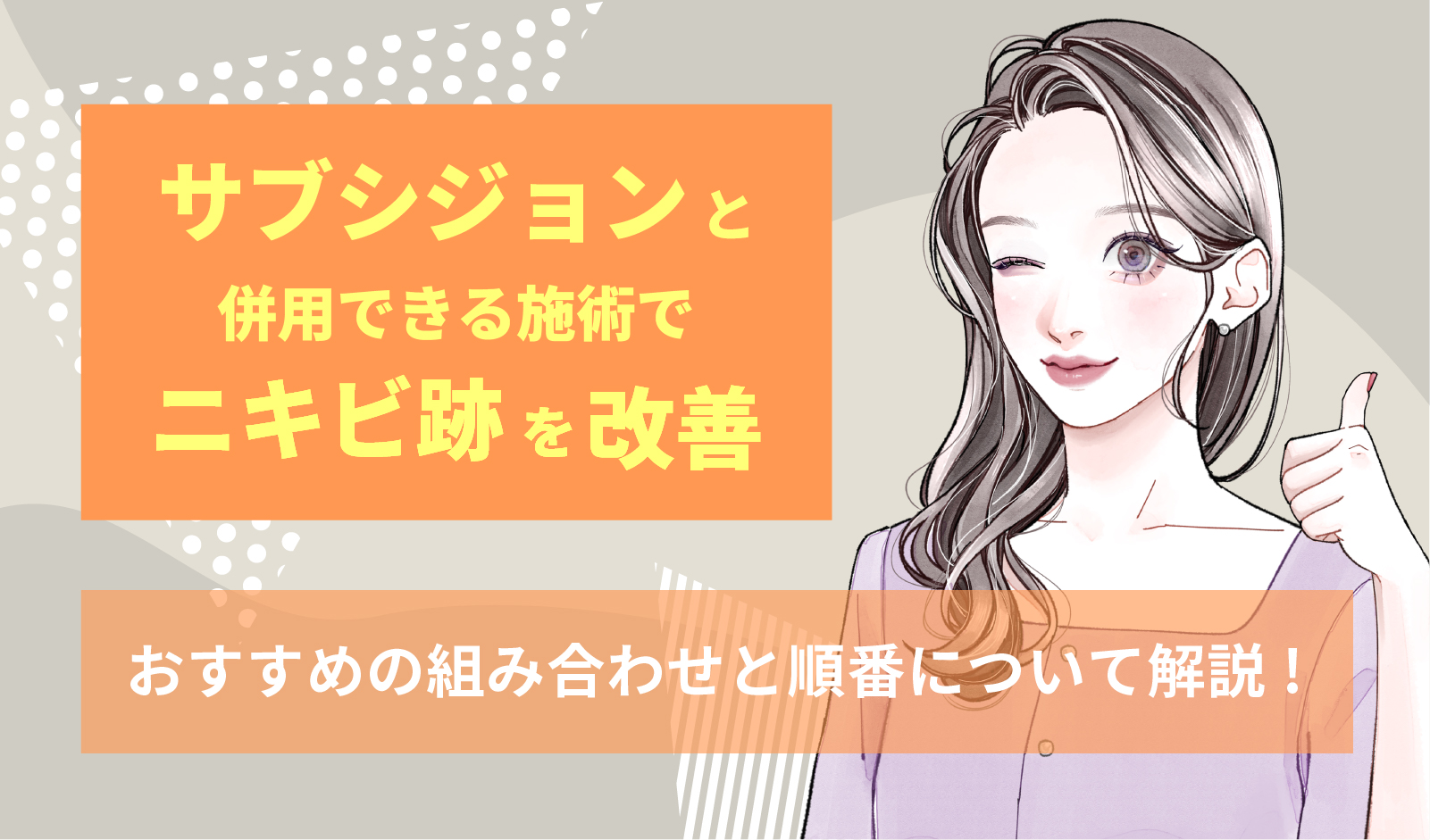
For those troubled by indented acne scars, Subcision is one effective treatment option. However, Subcision alone may not provide sufficient results in some cases. In such situations, combining it with other treatments may lead to greater improvement.
This article explains in detail the features and synergistic effects of treatments that can be combined with Subcision, as well as the recommended treatment order. Understand how to combine various treatments, including Potenza, Derma Pen, and Hyaluronic Acid Injection, and find the treatment plan that best suits you.






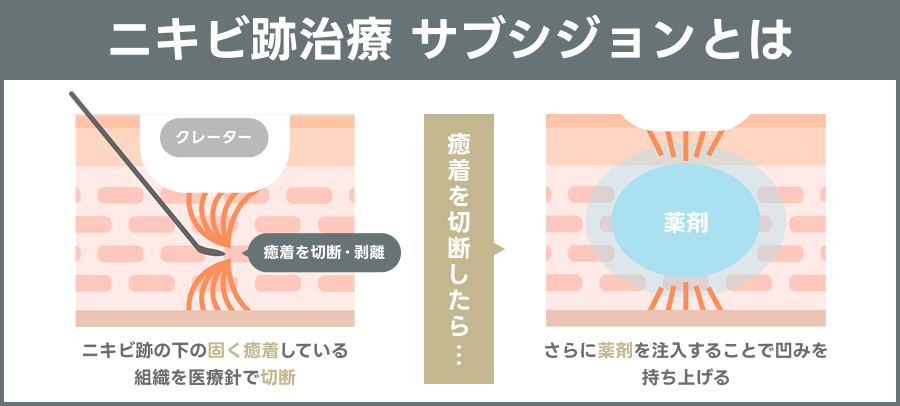
Subcision is a treatment that uses a special medical needle to cut the fibrous adhesions beneath the skin that cause indentations from acne scars. By physically separating the scar tissue pulling the skin downward, it improves indented scars.
It is particularly effective for rolling-type scars and can help relieve skin tension and firmness. After treatment, collagen production is promoted during the wound-healing process, enhancing the skin’s regenerative ability. Therefore, in addition to improving indentations, an improvement in skin quality may also be expected.
Combining Subcision with other treatments makes it possible to address various types of acne scars and maximize treatment results. Each treatment has its own mechanism of action, and combining them appropriately can create synergistic effects. Specifically, the following treatments can be combined.
When selecting combination treatments, it is important to comprehensively evaluate the type and depth of the scars, skin quality, and other factors to choose the optimal combination. Let us take a closer look at the features of each treatment and the key points when combining them with Subcision.
Juvgen Autologous Dermal Regeneration Treatment is an advanced aesthetic medical technology patented in Korea.
Using an ultra-fine injection needle, carbon dioxide gas and hyaluronic acid are repeatedly injected into the dermal layer of indented areas. This treatment generates a large amount of collagen fiber tissue, creates new skin, and raises the indentations.
One of the main causes of indented acne scars is fibrous adhesion deep within the skin following inflammation. Because this adhesion pulls the skin downward from within, treatments that approach only the surface may be difficult to improve in some cases.
Combining Juvgen with Subcision is an approach that aims for greater improvement by addressing both sides of the problem: releasing the adhesion causing the indentation through Subcision, and regenerating the patient’s own skin to improve the indentation at its source through Juvgen.
Please refer to this page for details about the treatment.
Potenza is an advanced treatment device that combines microneedles and RF (radio-frequency) energy. Ultra-fine needles are inserted into the skin, and RF energy is delivered from the needle tips to provide thermal stimulation to the dermis, which may promote collagen production.
The greatest benefit of combining Subcision and Potenza is that they improve indented skin through different approaches. Subcision physically separates adhesions, while Potenza promotes skin regeneration through thermal energy, so complementary effects may be expected.
When combining Subcision and Potenza, the general approach is to first release deep adhesions with Subcision and then improve the overall texture of the skin with Potenza 2–3 months later.
Treatment plans often consist of 3–5 Potenza sessions per course, performed once a month. Alternating treatments with Subcision may lead to more effective improvement. Ideally, the schedule for each treatment should be carefully planned so that they can be performed alternately.
A plan that considers the downtime of both treatments is necessary. Bruising and swelling may continue for 1–2 weeks after Subcision, so it is important to undergo Potenza only after complete recovery. Ignoring downtime may worsen the marks left by treatment.
It is also important to maintain appropriate intervals between treatments to minimize the burden on the skin. Adjust the treatment schedule according to your skin condition in consultation with your physician. It is also important to ask your physician to determine whether the treatment is appropriate for the effects you desire.
Derma Pen is a treatment that creates tiny holes in the skin with ultra-fine needles and promotes skin regeneration by utilizing the wound-healing process. While Subcision addresses deep adhesions, Derma Pen improves skin quality from the surface to the middle layers.
Combining the two makes it possible to approach layers of different depths at the same time, potentially producing more three-dimensional improvement. Derma Pen may play a complementary role, particularly for shallow scars that could not be fully improved with Subcision and for uneven skin texture.
Please refer to this page for details about the treatment.
When combining Subcision and Derma Pen, it is recommended to perform Subcision first and begin Derma Pen 1–2 months later. Addressing surface-level skin-quality concerns after releasing deep adhesions allows for more efficient treatment.
Skin-quality improvement can be experienced by receiving Derma Pen approximately once a month for 3–6 sessions. The number of sessions varies from person to person and is adjusted while monitoring the condition of the skin. Consult your physician to determine the number and intervals of treatments.
Derma Pen has relatively short downtime, but redness and swelling occur immediately after treatment. It is important to wait until the skin has completely recovered after Subcision before undergoing treatment. Redness and swelling may worsen, and it may become necessary to receive a separate medical examination or treatment.
Because both treatments create microscopic wounds in the skin, thorough aftercare is important. Support skin recovery with appropriate sun protection and moisturizing care.
Hyaluronic Acid Injection is characterized by an immediate volumizing effect. Injecting hyaluronic acid immediately after separating adhesions with Subcision can immediately lift the indentation. Among treatments combined with Subcision, this combination is known for being particularly compatible.
Filling the space created by separation may also help prevent re-adhesion. Although hyaluronic acid is gradually absorbed by the body, collagen production is promoted during this process, which may lead to long-term improvement.
Please refer to this page for details about the treatment.
Subcision and Hyaluronic Acid Injection can be performed on the same day. Injecting Hyaluronic Acid into the treated area immediately after separating the adhesions with Subcision may lead to more effective improvement.
A relatively firm-textured hyaluronic acid product is selected, and approximately 0.1–0.3 cc is injected per site. Because it is not necessary to leave an interval when combining treatment with hyaluronic acid, this option is recommended for people who have limited time but want effective treatment. The effects last approximately 6–12 months, and additional injections may be performed as needed.
Excessive injection may lead to an unnatural appearance, so it is important to use an appropriate amount. Even when treating multiple sites, treatment is recommended to proceed in stages. Approximately 0.1–0.3 cc per site is a guideline.
The duration and firmness vary depending on the type of hyaluronic acid, so it is important to select an appropriate product according to the condition of the scars. Develop the optimal treatment plan in consultation with your physician.
Juvelook is an injectable product whose main component is PDLLA (poly-D,L-lactic acid), and it has the effect of promoting collagen production over the long term. Unlike hyaluronic acid, it does not provide immediate effects, but it gradually improves skin quality over a period of 3–6 months.
Injecting Juvelook into areas separated by Subcision activates collagen production, which may improve not only indentations but also skin firmness and elasticity. It can be considered a suitable treatment for those who want to improve the overall quality of their skin.
Subcision and Juvelook can be performed on the same day or with an interval of 2–3 weeks. Injecting Juvelook immediately after separating the adhesions with Subcision may promote long-term collagen production while helping prevent re-adhesion at the separated site.
Juvelook often produces noticeable effects after 1–3 treatments, and an interval of approximately 1–2 months is recommended between treatments. Because the effects appear gradually, it is important to continue treatment without rushing.
Mild swelling or bruising may occur after Juvelook injections. When this overlaps with the downtime of Subcision, the treatment plan must take the recovery period into account. Performing Juvelook treatment without considering downtime may worsen swelling or bruising.
Because it takes time for the effects to appear, those seeking immediate results should also consider combining it with other treatments. Evaluate the treatment effects from a long-term perspective.
Lenisna is a product that can be considered an advanced version of Juvelook. It has a higher concentration of PDLLA and may provide a stronger volumizing effect. It is particularly effective for deep scars and extensive indentations, and may produce synergistic effects when combined with Subcision.
Injecting Lenisna after physically separating the adhesions with Subcision can immediately restore volume while also promoting long-term collagen production. This treatment may provide natural, lasting improvement.
While Juvelook is suitable for improving skin quality and shallow scars, Lenisna is particularly effective for deep scars and extensive indentations. Understanding this difference can help in selecting an effective treatment.
Subcision and Lenisna can be performed on the same day, but an interval of 2–3 weeks may also be left between treatments, taking the burden on the skin into consideration. Lenisna often produces noticeable effects after 1–3 treatments, and combining it with Subcision may make it possible to reduce the total number of treatments.
Initial swelling subsides approximately two weeks after injection, followed by a gradual increase in collagen over the next 3–6 months. Because improvement occurs gradually and naturally, this treatment may be less noticeable to those around you.
Because Lenisna has a higher concentration than Juvelook, adjusting the injection volume is important. Avoid excessive injection and aim for a natural result.
Mild swelling or bruising may occur after treatment, but appropriate aftercare can help minimize downtime. Follow your physician’s instructions and provide appropriate care.
TCA CROSS is a treatment for improving deep ice-pick scars using high-concentration trichloroacetic acid. Applying the product to the base of the scar intentionally causes inflammation and promotes collagen production.
TCA CROSS is highly effective for ice-pick scars, which are difficult to treat with Subcision. Combining the two makes comprehensive treatment for various types of scars possible.
When combining Subcision and TCA CROSS, it is important to use each treatment according to the type of scar. Subcision is used for rolling-type scars, while TCA CROSS is used for ice-pick scars, applying each treatment where it is most appropriate.
Both treatments may be performed on the same day, but they may also be scheduled on separate days depending on downtime, so consult your physician. An interval of approximately 4–6 weeks is recommended, and the next treatment is planned while monitoring the skin’s recovery.
Because TCA CROSS uses a strong chemical agent, there is a risk of inflammation and hyperpigmentation after treatment. When combining it with Subcision, a careful treatment plan that considers the burden on the skin is necessary.
Thorough sun protection is also important. Because the skin is sensitive after treatment, use sunscreen and protect the skin from light to help avoid the risk of hyperpigmentation.
Trifill PRO is a new treatment that uses natural suction technology to deliver products evenly beneath the skin. Because it can efficiently introduce products such as growth factors and hyaluronic acid into areas separated by Subcision, synergistic effects may be expected.
Trifill PRO enables efficient product delivery, particularly when treating extensive acne scars. After physically improving the area with Subcision, promoting skin regeneration with Trifill PRO may lead to improvement over a shorter period.
Please refer to this page for details about the treatment.
When combining Subcision and Trifill PRO, the general approach is to first separate the adhesions with Subcision and then introduce the product with Trifill PRO. Treatment on the same day is possible, but an interval of 2–4 weeks may also be left, taking the burden on the skin into consideration. Because this depends on the physician’s judgment, be sure to receive a thorough explanation of the treatment plan during your consultation.
A course of Trifill PRO often consists of 3–4 treatments, performed approximately once a month. Combining it with Subcision may make it possible to shorten the total treatment period.
Because Trifill PRO is a relatively new treatment, the number of clinics offering it is limited. It is important to confirm in advance which clinics can provide the treatment.
The effects and duration vary depending on the type of product introduced, so the product must be selected according to the treatment goal. Choose the optimal product in consultation with your physician. The physician’s and clinic’s experience is also an important factor in making a decision. Be sure to check this carefully before undergoing treatment.
CureJet is an advanced treatment that uses jet-stream technology to deliver products deep into the skin. Because it penetrates products into the skin with a high-pressure jet stream without using needles, it is characterized by less pain and shorter downtime.
After physically separating adhesions with Subcision, introducing active ingredients such as growth factors, vitamins, and hyaluronic acid with CureJet may enhance the skin’s regenerative ability. It can be considered a suitable combination treatment for people who are afraid of needles or want to minimize downtime.
When combining Subcision and CureJet, it is recommended to begin CureJet 2–3 weeks after Subcision. This may support the healing process in areas improved with Subcision and further promote collagen production.
CureJet can be performed once or twice a month, with treatment plans often consisting of 3–6 sessions per course. Because treatment sessions are also short, it is a treatment that may be easy to continue for people with busy schedules.
Because CureJet does not use needles, it can be performed relatively safely even on sensitive skin immediately after Subcision. However, it should be avoided when inflammation after treatment is severe.
The type and concentration of the product can be adjusted to customize treatment to each person’s skin condition, but it is important to avoid excessive stimulation and proceed with treatment in stages. Receive appropriate treatment according to your physician’s instructions.
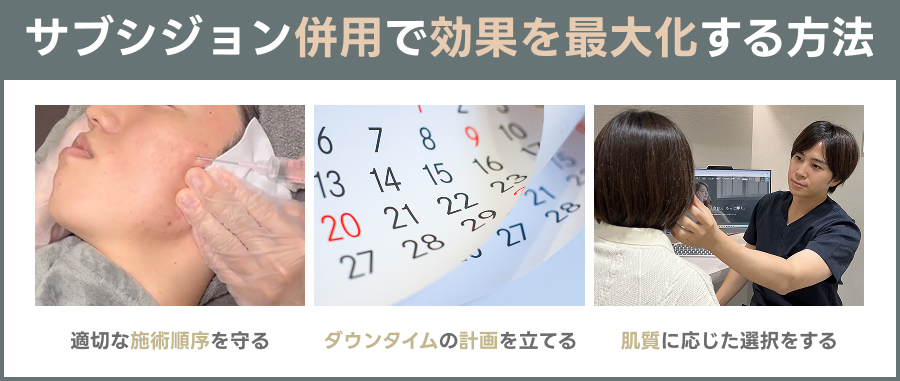
When combining Subcision with other treatments, keeping several important points in mind can help maximize treatment effects and allow you to receive treatment safely. Specifically, there are the following three points.
The important points for successful combination treatment are explained in detail below.
When combining multiple treatments, performing them in the appropriate order is key to maximizing treatment effects. Basically, the optimal order is to proceed from deeper layers to shallower layers and from physical treatments to chemical treatments.
Specifically, the ideal sequence is to release deep adhesions with Subcision, improve the middle layers with Potenza or Derma Pen, and finally refine the surface layer with Peeling. However, the optimal order varies depending on each person’s skin condition and scar type, so consultation with a physician is essential.
When undergoing combination treatment, a treatment plan that considers the downtime of each procedure is necessary. Bruising and swelling after Subcision may continue for approximately 1–2 weeks, and other treatments should be avoided during this period.
To minimize the impact on daily life, it may be necessary to use an extended vacation or proceed with treatments in stages. Appropriate aftercare following each treatment may also help shorten downtime and improve treatment effects.
Not every combination treatment is suitable for everyone. It is important to comprehensively evaluate skin quality, scar type, depth, and area, and select the optimal combination.
People with sensitive skin are recommended to begin with less irritating treatments and gradually progress. In addition, if you have atopic dermatitis or other skin problems, it is advisable to begin treatment after the symptoms have settled.
Combining Subcision with other treatments makes it possible to provide more effective treatment for various types of acne scars and indented skin. Combining it with Potenza or Derma Pen may achieve three-dimensional improvement, while injections of Hyaluronic Acid or Juvelook may offer both immediate and longer-lasting effects.
The important thing is to accurately understand your skin condition and scar type and select an appropriate combination of treatments. The order and timing of treatments, as well as downtime management, are also key to treatment success.
By consulting fully with a trusted physician and developing a treatment plan from a long-term perspective, you may achieve the skin you desire. Proceeding steadily without rushing may ultimately lead to satisfactory results.
※For treatments other than the full-face treatment, a separate local anesthesia fee of 22,000 yen will be charged.
※Anesthetic cream (optional): ¥3,300
※Nitrous oxide anesthesia (optional): ¥8,800
※Sedation Pack / 3,300JPY
※Acne and comedone extraction / 3,300 JPY (1 area)