How Painful Is Subcision? Explaining Anesthesia Options and the Post-Treatment Course

Language:
Language:



BLOG
When acne is left untreated or repeatedly develops in the same area, it can leave depressed acne scars. The skin becomes uneven, like the craters on the moon, making treatment difficult. However, this does not mean that treatment is impossible.
This article explains the types of acne scars, their causes, the types of depressed scars, and available treatments and their effects. If you are concerned about acne scars or want to improve depressed scars, please use this article as a reference.







In conclusion, it is difficult to treat depressed acne scars with self-care alone. Crater-like acne scars form when inflammation caused by repeatedly recurring acne destroys the structure of the pores around it, resulting in damage to the dermis. This creates unevenness in the skin.
Treating crater-like acne scars with self-care alone commonly takes several months or longer. To prevent acne from developing into crater-like scars, it is important to treat acne during its early stages.
Acne scars are the marks left on the skin after acne caused by inflammation in the pores has settled. Whether acne leaves scars depends on how severe the acne itself becomes and the person’s skin type. Even when the acne appears similar, the type of acne and differences in the skin’s healing ability mean that some people develop lasting scars while others do not.
There are several types of acne scars. As mentioned above, even when similar acne develops, the resulting scars differ depending on the skin’s healing ability and the severity of the acne. In addition, because the underlying causes of acne may differ, the same type of acne scar does not necessarily develop in every case.
The following sections explain the types of acne scars and their causes in detail.
Acne that leaves crater-like scars is deep-rooted acne in which inflammation has spread to the dermis. Although results vary from person to person, touching or squeezing acne with dirty hands is said to make crater-like acne scars more likely to form. Even mild acne can become larger when bacteria enter through areas that have been touched or squeezed.
Crater-like acne scars are extremely difficult to treat, and improving them through self-care or the skin’s natural turnover is considered difficult. Please be aware that treatment may take considerable time depending on the severity.
When inflammation occurs in the pores, the capillaries increase, leaving the skin with an overall reddish appearance. This type of acne scar is called post-inflammatory erythema. The redness may remain for some time after the inflammation has subsided, making it noticeable.
This type of acne scar generally fades naturally through the skin’s metabolism, known as turnover. However, if the inflammation occurs deep within the skin, it may take time to disappear completely.
Prolonged acne inflammation may cause melanin-related hyperpigmentation. Melanocytes become activated to protect the skin from inflammatory damage, producing large amounts of melanin where the acne occurred. As a result, that area alone may become light brown, leaving a discolored acne scar.
As with post-inflammatory erythema, the color gradually fades as the skin undergoes repeated turnover. However, if pronounced hyperpigmentation remains, it may not disappear completely, and the light-brown acne scar may persist.
A keloid-like scar is a raised area of skin at the site of an acne scar. It is thought to occur when inflammation from acne spreads to the dermis, resulting in excessive collagen production during the repair process.
Keloid-like scars are difficult to resolve naturally and require some form of treatment. If left untreated, they may worsen, and in the most serious cases, surgery may be necessary. If a keloid-like scar remains, seek treatment promptly at a dermatology clinic or cosmetic clinic.
There are also several types of depressed acne scars. The three main types are as follows.
The causes and recommended treatments differ for each type. Let us look at the causes, characteristics, and treatments for each type.
Rolling-type acne scars are approximately 5 mm to 1 cm in diameter. They form gently sloping depressions and are often roughly circular when viewed from above. They occur relatively close to the surface and do not destroy the epidermis or dermis.
Among the crater-like acne scars introduced in this article, rolling-type scars are the least noticeable. However, they may stand out depending on the lighting or viewing angle, so many people may still be concerned about them. Multiple rolling-type scars may also form close together, in which case they may be more noticeable than a single scar.
Rolling-type acne scars develop as a result of acne that releases pus when squeezed. They are said to occur particularly when the following conditions are present.
・Abnormal fibrous tissue (collagen) is produced, making the tissue hard and pulling the skin inward and downward
・Inflammation reaches the fatty tissue, and the skin is pulled inward as a result of fat atrophy
These acne scars occur because the skin has become depressed downward, rather than because the epidermis or dermis has been damaged. Think of the shallow layers of the skin as being pulled by fibrous tissue in the deeper layers.
Subcision is one recommended treatment. Subcision is a method of severing the abnormal fibrous tissue that is pulling on the skin. In rolling-type acne scars, this abnormal fibrous tissue pulls the epidermis downward. Treatment is performed to release this tension. Trifill PRO is another recommended treatment.
The scar becomes less noticeable over time after treatment, but in some cases, hyaluronic acid may be injected to raise the epidermis.
Boxcar-type acne scars are oval when viewed from above, with a flat base. They are called boxcar-type because they appear square when viewed from the side.
As mentioned above, a characteristic of boxcar-type acne scars is their flat base. They also appear square when viewed from the side because their edges are vertical. As with rolling-type acne scars, the epidermis is often pulled downward by abnormal fibrous tissue.
Rolling-type scars can be covered to some extent with makeup. However, because of their shape, boxcar-type scars are difficult to cover with makeup alone and tend to be more noticeable.
One cause of boxcar-type acne scars is the development of new acne in the same area while an earlier acne lesion is healing, resulting in a loss of part of the skin. Acne healing is said to take several months. If another acne lesion develops during this period, part of the skin may be lost. In addition, if abnormal collagen is produced in the subcutaneous tissue and pulls the skin downward, a boxcar-type acne scar may form.
Boxcar-type acne scars are also said to form when inflamed skin undergoes excessive fibrosis.
For shallow boxcar-type acne scars that do not reach the dermis, treatment is performed with Subcision or Trifill PRO. After removing the angular areas, the recommended treatment for shallow scars is to sever the abnormal fibrous tissue, as with rolling-type acne scars, and wait for natural healing.
For shallow scars, treatment with Derma Pen or Peeling is also recommended. However, as with rolling-type scars, Trifill PRO is the most recommended treatment.
When the acne scar extends into the dermis, the recommended treatment is to perform Subcision followed by hyaluronic acid injections. As crater-like scars become deeper, strong adhesions are often present at the base. Therefore, even if the same treatment used for shallow scars is performed, the scar may recur.
When a boxcar-type acne scar is relatively deep, a collagen booster called Juvelook is injected to prevent recurrence. Juvelook promotes collagen growth in the separated area, raising the epidermis. It can also help prevent re-adhesion in the same area.
Ice pick-type acne scars are small when viewed from above. Their diameter is 2 mm or less, so they may appear less noticeable than the other acne scars introduced here. However, they often extend into the subcutaneous tissue and are said to be the most difficult acne scars discussed in this article to treat.
Although ice pick-type acne scars are small when viewed from above, they often extend deeper than the dermis and may reach the subcutaneous tissue. In cross-section, they resemble a puncture wound made by a sharp ice pick, which is how they received their name.
Ice pick-type acne scars develop because the skin becomes fibrotic along the pores. When pus is discharged from the pores over a long period due to acne or other causes, the pores gradually become hardened. Eventually, a small opening called a fistula forms, resulting in an ice pick-type acne scar.
For relatively shallow ice pick-type scars, the recommended treatment is to remove the affected area with a carbon dioxide laser and wait for natural healing. Shallow acne scars tend to have a larger diameter than deep ice pick-type scars. Therefore, removing only the surface skin with a carbon dioxide laser may make them less noticeable.
For deep ice pick-type acne scars, the recommended treatment is to remove the scar with a carbon dioxide laser and then sever the scar tissue with Subcision. As with rolling- and boxcar-type scars, deep acne scars often have adhesions at the base. Subcision is necessary for a clean result.
Trifill PRO is recommended for both shallow and deep cases. As described below in more detail, it is a treatment that combines Subcision and hyaluronic acid injections in a single session. It can help prevent re-adhesion and improve the appearance of the skin, making it a recommended option.
When treating depressed acne scars with self-care, it is necessary to determine which type of depression is present. Among the types introduced above, relatively shallow acne scars may be expected to improve with self-care.
However, even shallow crater-like acne scars may sometimes require the scar tissue to be severed. Trying self-care treatment first is one option, but if no improvement is seen, consulting a medical institution is recommended.
Over-the-counter medications cannot resolve shallow crater-like acne scars whose underlying causes have not been addressed, or acne scars that extend below the dermis. This is because ingredients in over-the-counter medications reach only the skin’s surface layers and do not penetrate deeply into the skin.
Using them continuously for an extended period may make the depressed area smoother. However, this does not resolve the underlying cause, so it is important to understand that the scar has not necessarily been completely treated.

Several treatment methods are available for crater-like skin. The following seven are representative options.
These treatments cannot be performed through self-care; treatment using specialized equipment at a cosmetic clinic or dermatology clinic is necessary. In addition, the applicable treatment differs depending on the type of acne scar. Let us look at the characteristics and precautions for each treatment in detail.
Trifill PRO is a treatment device that makes acne scars less noticeable by injecting CO2 gas and medication into scar tissue in sequence. By horizontally separating the scar tissue and releasing the adhesions, it promotes collagen production and can make acne scars less noticeable.
Compared with Subcision, it is characterized by less bleeding and shorter downtime. It also carries a lower risk of hyperpigmentation, making it recommended for people who have not seen results from various other treatments. In addition to acne scars, it may also help improve nasolabial folds.
Ellisis Sense (Needle RF) is the next-generation device following Potenza, described below. It may help improve acne, acne scars, enlarged pores, and other scars. In a single treatment, the device can provide wound healing stimulation with microneedles, tightening with thermal energy, and medication delivery.
Compared with conventional Potenza, a major difference is that radiofrequency is delivered twice. This is called a double shot and is one of the advantages of Ellisis Sense (Needle RF). It may produce greater effects than Potenza.
Microneedles are associated with little pain, and treatment time is short, generally around 20–30 minutes. The short downtime is also an advantage. However, side effects such as redness and peeling may occur. They generally subside within one week at the longest, but please be aware that side effects may occur.
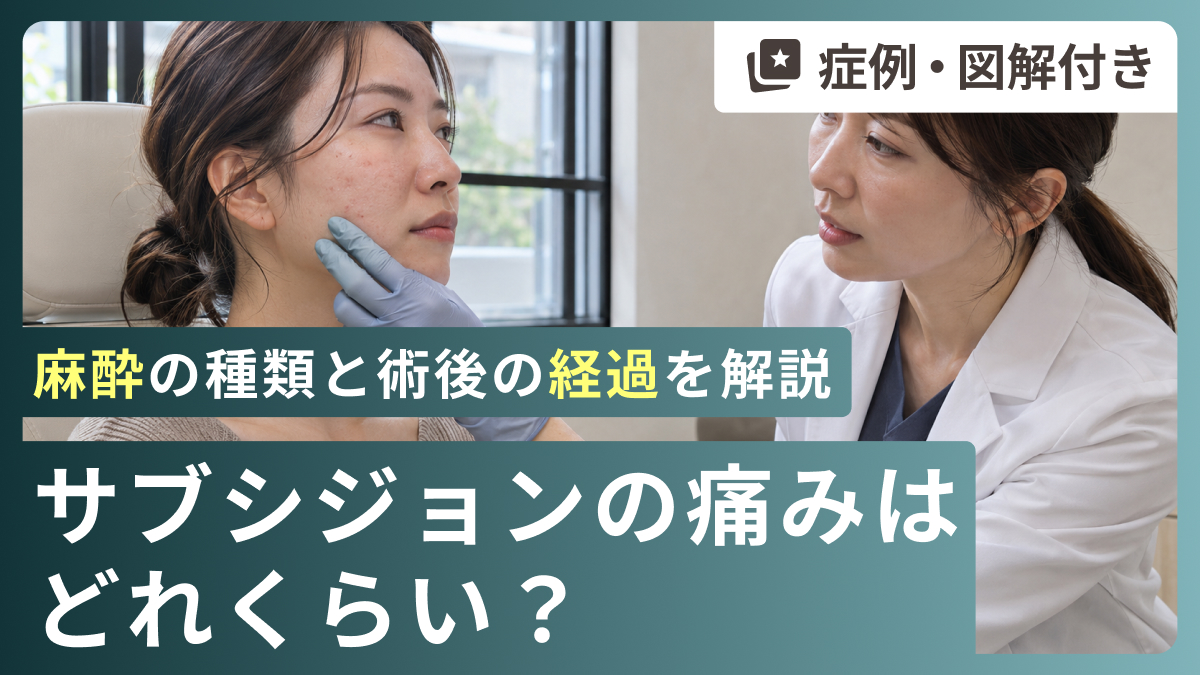
Subcision is a treatment that uses a fine needle to horizontally sever scar tissue. A long needle called a cannula is used to cut the fibrous tissue beneath the acne scar. Depending on the condition of the acne scar, hyaluronic acid may be injected, and a cannula is also used for this procedure.
Local anesthesia is administered before treatment, so the procedure is characterized by little pain. In addition, because the cannula is thin, it causes less damage to the skin and offers the advantage of making bruising and surgical marks less likely. Side effects may include swelling, bruising, redness, and puffiness, but these generally subside in about one week.
Please note that Subcision usually requires one to three treatments at regular intervals. In some cases, it may also be combined with another treatment such as Derma Pen. Consult your physician carefully before treatment and confirm which treatment plan will be used.
Hyaluronic acid injection is a treatment in which hyaluronic acid is injected beneath an acne scar to raise the skin. It is often performed together with treatments such as Subcision and may also be used to help prevent re-adhesion.
Because hyaluronic acid is a substance that naturally exists in the body, it is characterized by relatively few side effects. It is absorbed by the body within about one year after treatment and is less likely to leave a lasting mark. Because of these properties, it is commonly used not only to treat acne scars but also nasolabial folds and wrinkles.
Whether hyaluronic acid should actually be injected is determined by the physician. It may not be necessary depending on the condition of the acne scar, so please seek your physician’s opinion carefully during the consultation before treatment.
Derma Pen is a treatment that uses a medical device equipped with multiple fine needles to make acne scars less noticeable. It may be used for shallow depressed acne scars or in combination with Subcision.
Unlike Subcision, which improves depressions from within, Derma Pen stimulates the skin from the outside with needles to promote collagen production. It may be expected to promote skin turnover and improve enlarged pores and hyperpigmentation associated with acne scars.
Peeling products may also be used during Derma Pen treatment. They promote the skin’s regenerative capacity and may help improve skin quality. As with Subcision, multiple treatments are required.
Laser treatment is a method that uses a laser to create tiny holes in the skin’s surface and improve crater-like scars by utilizing the skin’s natural healing ability. As surrounding cells repair the wounds created by the laser, collagen is produced and the acne scars become less noticeable.
Because a laser is used, anesthetic cream must be applied beforehand. Redness or a stinging sensation may occur immediately after treatment. For about 10 days after treatment, the skin may also feel rough, but these symptoms generally subside naturally.
After treatment, care against infrared radiation must not be overlooked. The skin is sensitive after laser irradiation, and exposure to ultraviolet rays makes hyperpigmentation and sunburn more likely. The physician will explain sun protection after treatment in advance, so please listen carefully.
Potenza is a treatment method that creates holes in the skin’s surface with fine needles and uses high-frequency energy emitted from the needle tips. It is equipped with a pumping function, which offers the advantage of injecting the medication used evenly into the dermis.
Treatment takes longer than other methods and may take approximately two hours in some cases. Multiple treatment sessions may also be required, and compared with other methods, these are areas where Potenza may be less advantageous. However, being able to expect three types of treatment and effects from a single Potenza session can be considered a significant advantage.
People who have dental treatment with implants or bridges, or who have a metal allergy, cannot receive Potenza treatment. Please also note that people with a tendency to develop keloids may likewise be unable to choose Potenza.
Depending on their depth and type, depressed acne scars cannot be expected to be fundamentally resolved through self-care alone. For a fundamental solution, cosmetic medical treatment is recommended. Crater-like acne scars are difficult to resolve on your own. Consult a physician carefully and address your acne scars with an appropriate treatment method.
Today, there are many ways to treat depressed acne scars. Please consult a physician to determine your skin type and the condition of your acne scars and receive appropriate treatment. At our clinic, we propose suitable treatment methods according to each patient’s skin type and wishes. If you would like to make depressed acne scars less noticeable or learn more about the actual treatment methods, please feel free to consult us.
※For treatments other than the full-face treatment, a separate local anesthesia fee of 22,000 yen will be charged.
※Anesthetic cream (optional): ¥3,300
※Nitrous oxide anesthesia (optional): ¥8,800
※Sedation Pack / 3,300JPY
※Acne and comedone extraction / 3,300 JPY (1 area)