
ADVATx-LASER vs Vbeam: How to Choose and Use Them for Different Symptoms, Clearly Explained with Images

Language:
Language:



BLOG
“I heard they work for redness, but which should I choose—ADVATx-LASER or Vbeam?” Many people have this question. Both are often introduced in cosmetic dermatology as standard treatments for redness, making them two of the most difficult devices to distinguish.
This article organizes the mechanisms and differences between the two devices, compares them with other treatments such as Pico Toning, Photofacial, and HydraFacial, and explains how to choose between them based on your symptoms.








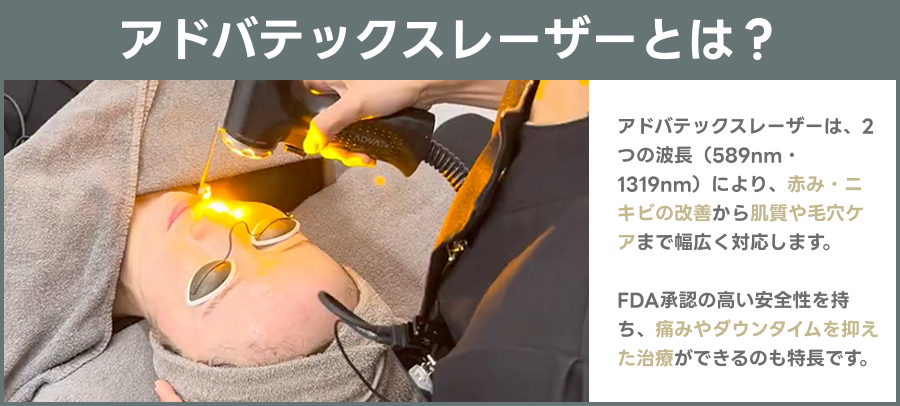
ADVATx-LASER is a relatively new laser device developed by an American medical-device manufacturer. Its key feature is that it can simultaneously emit two wavelengths, 589 nm and 1319 nm, from a single device. It has received approval from the FDA, the U.S. Food and Drug Administration, for 25 conditions.
Its features can be summarized as “a laser that improves redness, acne, pores, and sebum all at once.” Its proprietary “soft pulsing technology” enables ultra-high-frequency irradiation of 240 pulses in 0.02 seconds. The device is designed to produce results while minimizing downtime. In many cases, makeup can be applied on the day of treatment, making it increasingly popular as a treatment that can be continued around everyday activities.
For more information about ADVATx-LASER, please see the article below.
Vbeam is a type of laser called a pulsed dye laser (PDL) that emits a single wavelength of 595 nm. This wavelength is strongly absorbed by hemoglobin in the blood, and the device is specifically designed to selectively destroy abnormally dilated capillaries.
It can be described as “the standard redness-treatment laser that directly targets blood-vessel lesions.” It has a long track record in treating lesions caused by blood vessels, including hemangiomas, severe telangiectasia, and hypertrophic scars, or raised scars. It is also widely used in cosmetic dermatology and dermatology clinics in Japan, and another feature is that some symptoms may be treated under Japan’s health insurance system.
Both Vbeam and ADVATx-LASER use wavelengths that strongly react with hemoglobin, the red pigment in blood. They are therefore considered effective for “inflammatory redness,” including facial redness, telangiectasia, and red acne, and have traditionally been discussed in the same category. The comparison appears frequently in searches because many people are unsure which is better.
However, their design concepts are clearly different. Vbeam takes the approach of “directly targeting blood vessels with a single wavelength,” while ADVATx-LASER is designed to “simultaneously target multiple targets with two wavelengths.” This difference affects indications, pain, downtime, and treatment frequency, so there is no simple answer to the question of which is superior. Choosing the device that suits your concerns is important.
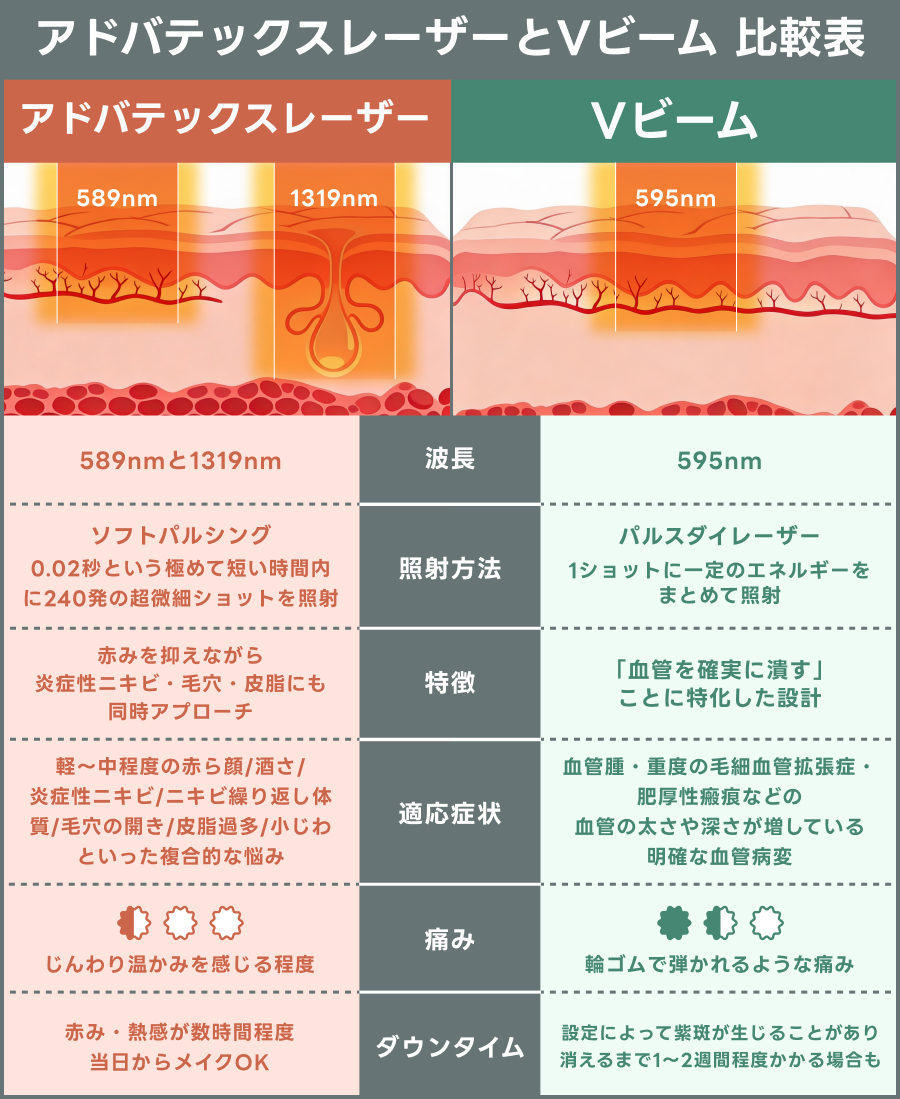
ADVATx-LASER and Vbeam both treat redness and acne scars, but their approaches and target symptoms differ. Learn which may suit your symptoms.
Although both devices are classified as “redness lasers,” they differ in many respects, including wavelength, irradiation method, cooling technology, and downtime. Below, we explain them in detail from nine perspectives.
1. Differences in wavelength and treatment purpose
2. Differences in irradiation method
3. Differences in cooling technology and pain
4. Differences in spot size and irradiation precision
5. Differences in indications
6. Differences in downtime
7. Differences in number and frequency of treatments
8. Differences in certifications and approvals
9. Differences in general pricing
If you are unsure which treatment to choose, please use this information as a reference.
Vbeam uses a single wavelength of 595 nm. It has a high absorption rate for oxyhemoglobin and concentrates energy directly on abnormally dilated capillaries to destroy them. It is specifically designed to “reliably destroy blood vessels.”
ADVATx-LASER, on the other hand, can simultaneously emit two wavelengths: 589 nm and 1319 nm. Although 589 nm is close to Vbeam’s 595 nm, it has a different role and helps calm inflammation. The 1319 nm wavelength is not found in Vbeam. It reaches the dermal layer, promotes collagen production, and suppresses sebaceous gland activity. Its ability to target pores and sebum while also reducing redness is a strength that Vbeam does not offer.
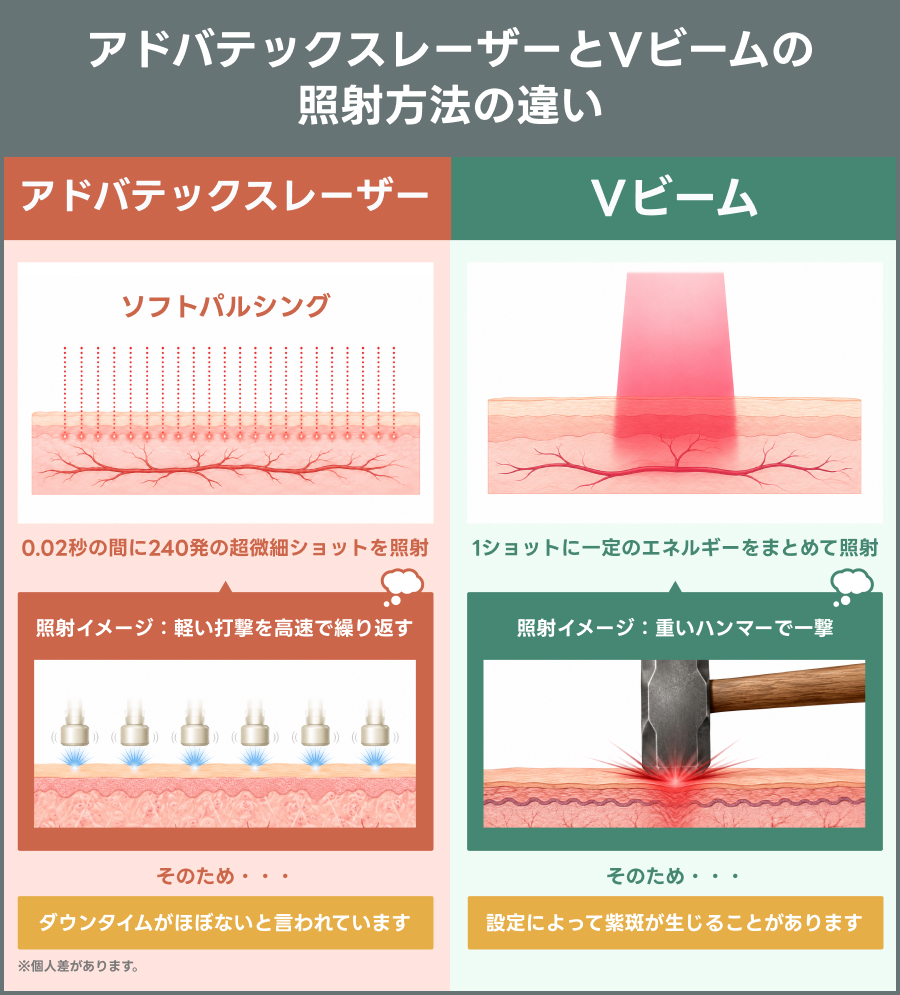
Vbeam is a pulsed dye laser that delivers a fixed amount of energy in a single shot. While the concentration of energy gives it strong power to destroy blood vessels, it can also spread to surrounding tissue, sometimes causing purpura, or bluish bruising resembling internal bleeding.
ADVATx-LASER’s “soft pulsing” technology delivers 240 ultra-fine shots within an extremely short period of 0.02 seconds. By intentionally dispersing the energy in each shot and building it up at high frequency, it produces a cumulative effect on the target while minimizing damage to surrounding tissue. Vbeam is like delivering one powerful blow with a heavy hammer, while ADVATx-LASER is like repeatedly delivering light blows at high speed.
Vbeam uses cryogen cooling, or dynamic cooling device (DCD) technology, which sprays cooling gas at the same time as the laser is emitted. Because the skin surface is cooled instantly before irradiation, heat-related pain is reduced. However, many people experience sharp pain similar to sunbathing in strong sunlight when a high-energy setting is used.
ADVATx-LASER uses a built-in cooling system to cool the skin during irradiation, in addition to the low-damage design of soft pulsing itself. Because the energy is dispersed in each shot, many people describe it as less painful than Vbeam, and it can often be received without anesthetic cream. This is one practical reason it is chosen as a treatment that is easy to attend between work commitments.
Spot size refers to the area covered by one laser shot on the skin. Vbeam commonly has a spot size of approximately 7–10 mm, allowing it to cover a wide area at once. This design is advantageous when treating hemangiomas or widespread redness.
ADVATx-LASER has a relatively small spot size, and the treatment area can be controlled in detail in combination with fractional irradiation. Since the output can be adjusted for each area, it offers greater precision for delicate areas such as around the nose and eyes.
Vbeam may be suitable when you want to treat a large area quickly, while ADVATx-LASER may be suitable when detailed control by area is needed.
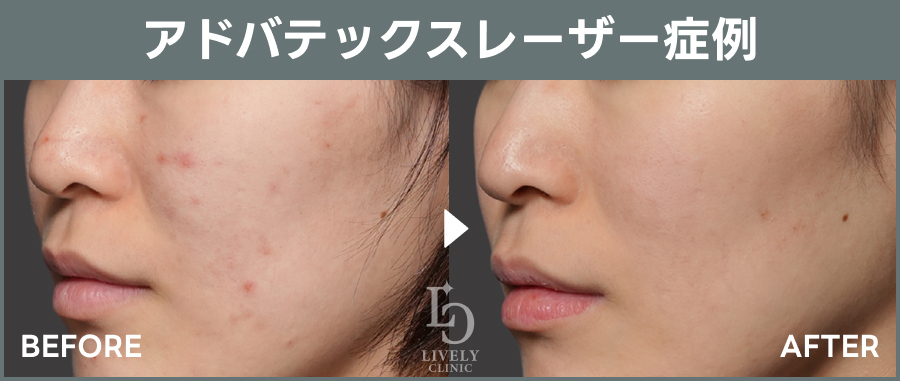
Vbeam has an advantage for clearly defined vascular lesions in which the blood vessels have increased in width or depth, such as hemangiomas, including strawberry hemangiomas and capillary hemangiomas, severe telangiectasia, and hypertrophic scars, or raised scars. Vbeam may be advantageous when you want to “reliably destroy blood vessels.”
ADVATx-LASER, on the other hand, has an advantage for combined concerns such as mild to moderate facial redness, rosacea, inflammatory acne, a tendency toward recurrent acne, enlarged pores, excess sebum, and fine lines. Since it can target multiple symptoms in one treatment, it suits the needs of people who want to “improve everything together.”
Melasma may worsen with heat, so both treatments require careful output settings.
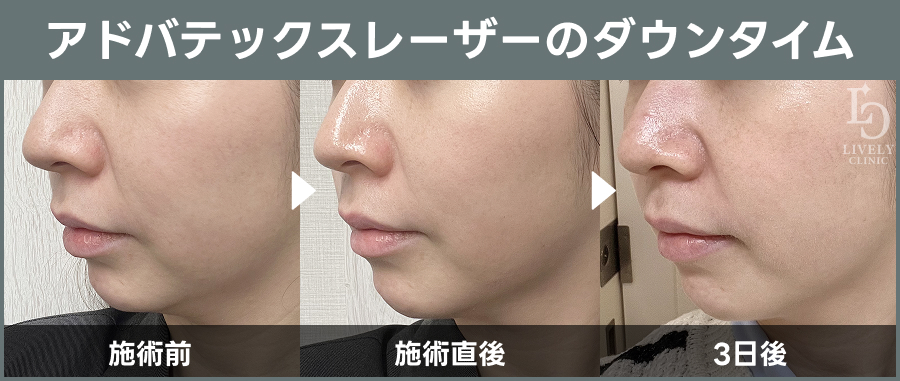
The difference in downtime directly reflects the difference in irradiation methods. With ADVATx-LASER, redness and warmth immediately after treatment often settle within a few hours, and in many cases makeup can be applied the same day. Noticeable symptoms rarely remain from the following day onward; depending on the treatment area and output, slight redness may continue for several days.
Vbeam may cause purpura depending on the settings, and it may take approximately 1–2 weeks to disappear. Purpura also reflects Vbeam’s strong ability to destroy blood vessels, so it cannot simply be considered a disadvantage. However, it may be a practical limitation when considering its effect on work or going out. Vbeam Prima can also be used with a low-output, no-downtime setting, although the effect per treatment is correspondingly more limited.
ADVATx-LASER generally begins to show results after a series of approximately 3–5 treatments, performed at intervals of around once a month. Because it is designed to cause little damage, there is no need to wait a long time for the skin to recover before the next treatment, making it easy to continue as regular maintenance.
Vbeam also requires multiple treatments, but when purpura occurs, it is necessary to wait until it has completely disappeared before proceeding with the next treatment. Treatment for hemangiomas is often performed approximately once every 1–2 months. For people who want to continue visiting for treatment, ADVATx-LASER may make it easier to create a practical treatment schedule.
ADVATx-LASER has received authorization from the U.S. FDA, the U.S. Food and Drug Administration, and the European CE mark, and its use is approved for more than 25 indications in total. Although it has not yet received approval from Japan’s Ministry of Health, Labour and Welfare, it is positioned as a highly safe device. Vbeam also has a long clinical track record and is widely used in Japan and other countries.
Both devices have evidence supporting their safety, but ADVATx-LASER’s “international approval for multiple conditions” is one indicator of reliability when selecting a device. The presence and scope of approvals can also serve as a reference for understanding the characteristics of each device.
Although prices vary considerably by clinic, ADVATx-LASER is often priced higher than Vbeam because it is a relatively new device. Since Vbeam is widely available in Japan, some clinics offer it at comparatively reasonable prices due to market competition.
However, caution is needed when choosing based simply on “the cheaper option.” Both effectiveness and risks vary according to the output settings, treatment area, and practitioner’s skill. It is important to treat price as reference information and make your choice while comparing it with the explanations provided during counseling.
The detailed comparison is provided above, but here is a simple guide to help you when making an actual choice.
Vbeam is suitable when there is a clearly defined lesion where you want to reliably destroy blood vessels, such as a hemangioma, severe telangiectasia, or hypertrophic scar. It may also suit those who can accept downtime and want treatment at a certain intensity. Since some symptoms are eligible for insurance-covered care, seeing a dermatologist may be an option in some cases.
ADVATx-LASER is suitable for people with multiple concerns, such as facial redness, rosacea, acne, enlarged pores, and excess sebum, who want to improve them continuously while minimizing downtime. If you value being able to attend treatment without interrupting work or daily life, as well as additional effects on pores and sebum, this is a treatment worth considering first.
However, it is not possible to determine which is better suited to your symptoms without directly examining your skin. First, seek a doctor’s opinion.
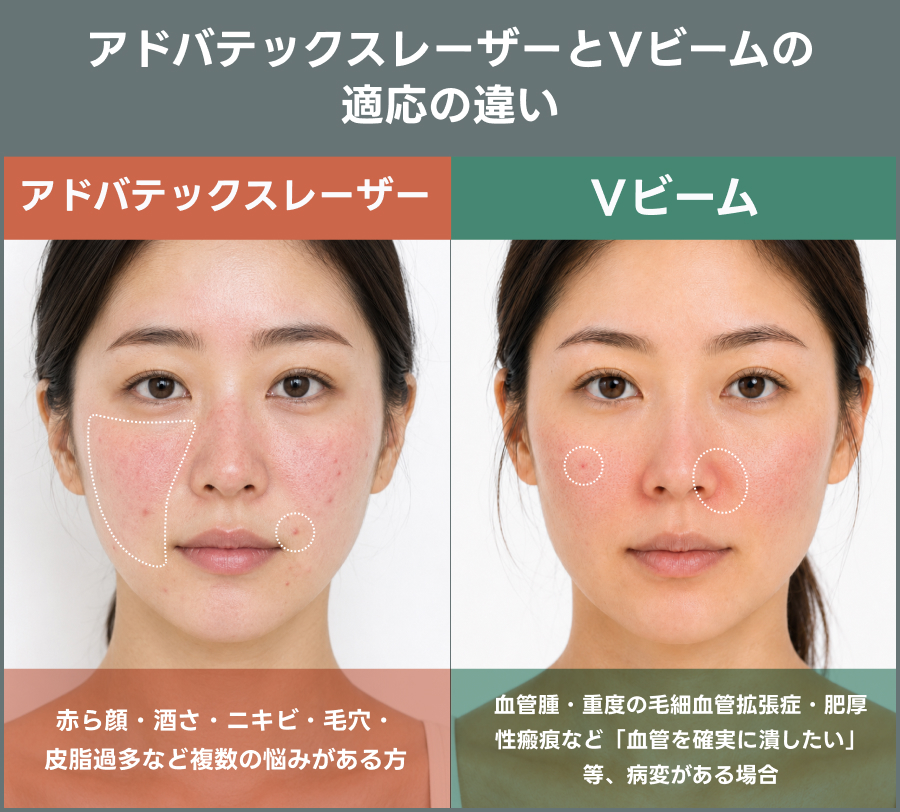
Which is better suited to you, ADVATx-LASER or Vbeam, varies according to the type, severity, and location of your symptoms. Here, we organize information on four representative symptoms.
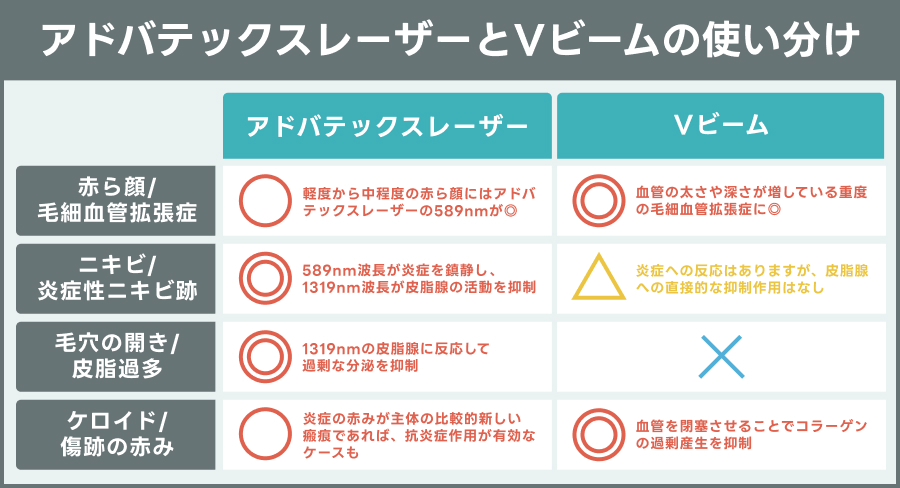
For mild to moderate facial redness, ADVATx-LASER’s 589 nm wavelength may be an option that makes it easier to produce results while minimizing downtime. It is also indicated for conditions such as rosacea, in which inflammation and dilated blood vessels are intertwined, and it can reduce the baseline level of redness through repeated treatments.
For severe telangiectasia in which the blood vessels have increased in width or depth, or for prominent thick vessels around the nose, Vbeam’s strong pulse energy may be effective in some cases. Even for the same “facial redness,” the appropriate device varies according to the diameter and depth of the capillaries, so the starting point for making a decision is to have the condition of the blood vessels examined at a clinic.
This is an area in which ADVATx-LASER has an advantage. The 589 nm wavelength reacts with porphyrins produced by acne-causing bacteria to directly calm inflammation, while 1319 nm suppresses sebaceous gland activity. Its ability to target both “the inflammation of existing acne” and “the sebum environment that makes acne likely to develop” in one treatment is a feature Vbeam does not offer.
Vbeam also reacts to inflammation, but it does not directly suppress sebaceous glands. From the perspective of improving a tendency toward recurrent acne, ADVATx-LASER may make it easier to expect an effect in suppressing recurrence.
This is an area uniquely covered by ADVATx-LASER, which includes the 1319 nm wavelength. Promoting collagen production in the dermal layer tightens the skin around the pores, while suppressing sebaceous glands can also address chronic concerns about shine in the T-zone.
This effect cannot be expected from Vbeam, making the distinctive qualities of ADVATx-LASER particularly clear when pore improvement is the primary goal. For people with combined concerns about both pores and redness, ADVATx-LASER is an efficient option because it can target both with one device.
Vbeam has a long track record in treating postoperative scars and hypertrophic scars. Its mechanism of reducing excessive collagen production by occluding blood vessels is considered to contribute to flattening hypertrophic scars.
On the other hand, ADVATx-LASER’s anti-inflammatory effect may be effective in some cases of relatively new scars in which inflammatory redness is the main concern. The optimal device varies according to the nature of the scar, whether it is flat or raised, how long it has been present, and the intensity of the redness. Therefore, neither should be selected based on self-assessment; an examination at a clinic is a prerequisite for making a choice.
Cosmetic dermatology offers many treatments for improving skin concerns. Here, we organize the differences between ADVATx-LASER and treatments it is often compared with.
Pico Toning uses a picosecond laser at low output to gradually break down melanin pigments, improving spots, dullness, and melasma. Its primary purpose is to target melanin, so little direct effect on redness or vascular lesions can generally be expected.
ADVATx-LASER is not a device centered on destroying melanin. Therefore, if someone wants to improve both spots and redness with one device, there may be limits to the effect on one of these concerns.
Since their areas of strength are clearly different, the practical choice is to use them according to the priority of your concerns or combine them when necessary.
Photofacial uses light with multiple wavelengths, known as IPL, or intense pulsed light, to target multiple concerns at once, including spots, freckles, capillaries, and acne. Because it uses a broad range of wavelengths, it is not designed to concentrate energy as strongly on specific targets, such as hemoglobin and sebaceous glands, as ADVATx-LASER does. Instead, it tends to gradually promote overall skin-quality improvement.
ADVATx-LASER can target severe redness or chronic pore and acne concerns more strongly, while Photofacial may be suitable for people who want to care for spots, dullness, and redness together or improve the overall condition of their skin.
HydraFacial is a water-flow-based peeling treatment that infuses cosmetic ingredients while suctioning impurities from the pores. It is noninvasive and involves no downtime, and it can remove physical blockages in the pores and surface-level sebum.
The difference from ADVATx-LASER is the depth of action. HydraFacial targets the area from the skin surface to the openings of the pores. It cannot be expected to promote collagen production in the dermal layer or functionally suppress sebaceous glands. However, because the treatment places very little burden on the skin, it is often combined in practice as preliminary care: “first prepare the skin condition, then move on to laser treatment.”
Electroporation uses electrical pulses to create temporary gaps in the cell membranes of the skin, allowing cosmetic ingredients to penetrate deeper. Since its purpose is to deliver ingredients, it does not directly treat redness, pores, or acne, and its role is fundamentally different from that of ADVATx-LASER.
However, replenishing cosmetic ingredients with Electroporation after ADVATx-LASER treatment may produce a synergistic effect that enhances the treatment results, so many clinics combine them as a combination menu. Rather than choosing “which one to receive,” it is appropriate to view Electroporation as an option added to ADVATx-LASER.
LIVELY CLINIC offers ADVATx-LASER treatment. During counseling, we carefully address questions such as “Which is better suited to me, Vbeam or ADVATx?”, “I am concerned about both pores and acne,” and “I do not know whether my redness is caused by blood vessels or inflammation.”
Choosing the appropriate device requires examining the skin directly. Rather than trying to make a decision based only on information online, having a specialist examine your current skin condition is one of the most direct ways to improve treatment satisfaction. Please feel free to consult us.
Although ADVATx-LASER and Vbeam belong to the same “redness laser” category, they clearly differ in wavelength, irradiation method, cooling technology, downtime, and indications. Vbeam is designed to directly target blood vessels and has an extensive track record for vascular lesions. ADVATx-LASER’s strengths are its ability to target redness, acne, pores, and sebum across multiple concerns with simultaneous emission of two wavelengths and soft pulsing, while minimizing downtime. Treatments such as Pico Toning, Photofacial, and HydraFacial each have different areas of strength.
Rather than asking “Which is superior?”, choosing based on “What suits my concerns and lifestyle?” can lead to greater treatment satisfaction. If you are unsure which option is right for you, please consult LIVELY CLINIC.
※Implementation Clinics: Osaka Clinic, Hamamatsucho Clinic
*Limited to first-time clients only
※Implementation Clinics: Osaka Clinic, Hamamatsucho Clinic
※Implementation Clinics: Osaka Clinic, Hamamatsucho Clinic