Want to Improve Acne-Scar Depressions? Learn About Their Causes and Effective Treatments

Language:
Language:



BLOG

Many people, from children to adults, struggle with acne. Particularly severe acne can cause wounds, and even after they close, discoloration or unevenness may remain, resulting in stubborn acne scars.
Even if you want to improve your acne scars, there are many treatment options, so you may wonder which treatment is effective for your scars.
Here, we focus on Subcision, a treatment expected to be effective for particularly deep depressions among the uneven acne scars that remain on the skin. We explain the procedure, the types of acne scars for which it is effective, and actual Subcision cases in detail.







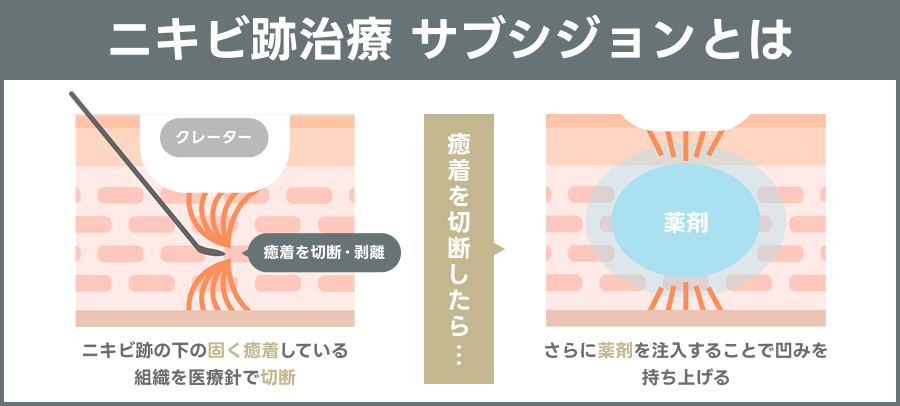
Subcision is a treatment designed to improve uneven skin and depressions left by acne scars.
Acne scars commonly appear as redness, brownish discoloration caused by hyperpigmentation, or depressions (atrophic scars). Acne-scar depressions occur when inflammation caused by acne damages the tissue beneath the skin, causing fibrosis that hardens the tissue and pulls the skin inward.
Subcision is particularly suitable for acne scars with broad depressions. A needle is inserted diagonally into the skin to cut the hardened tissue caused by fibrosis, lifting the depressed area and improving the acne-scar depression.
Derma Pen is also used to treat acne scars, but it is more suitable for broad, shallow scars. Subcision can be effective for deep acne scars that may not improve sufficiently with Derma Pen.
Subcision is a procedure that may be effective for deep acne scars (atrophic scars) that cannot be improved with fractional laser, Potenza, Derma Pen, or Peeling alone.
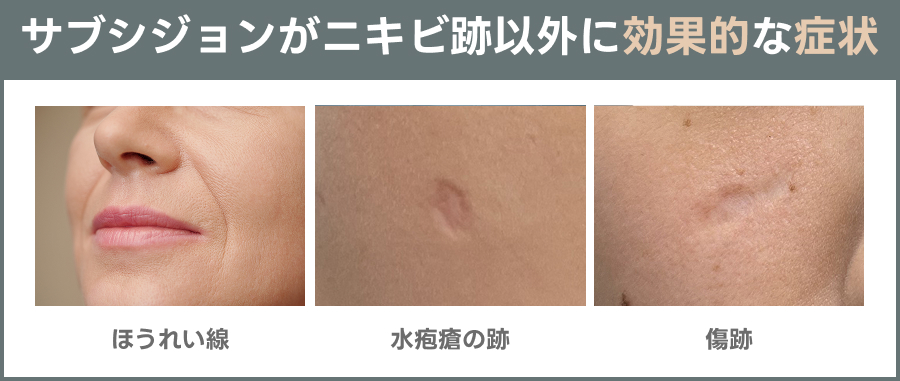
In addition to deep acne-scar depressions, Subcision may also be used to improve depressions caused by the symptoms below.
Acne-scar atrophic scars can be divided into four types.
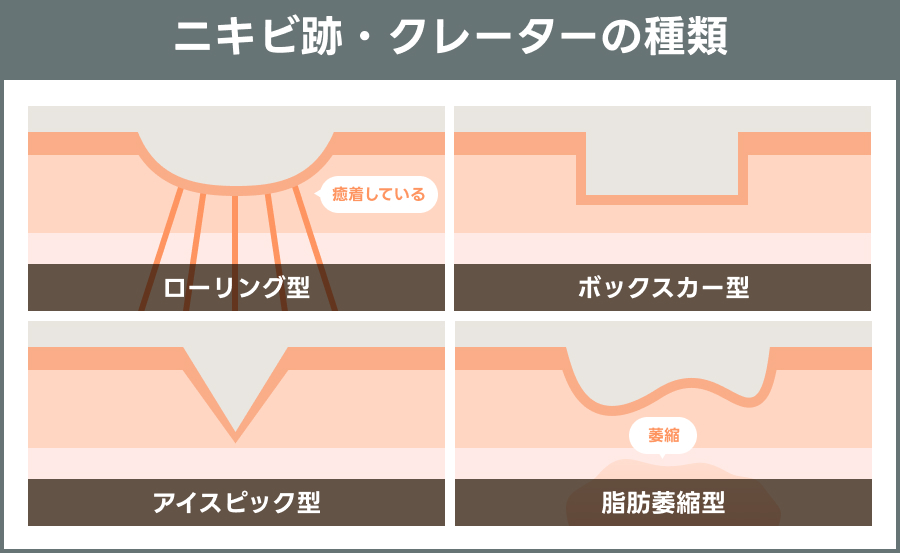
Among these, Subcision is effective for acne scars with residual atrophic depressions. It is most effective for rolling scars. In contrast, ice-pick scars are less likely to respond. Let us look at the characteristics of each type of atrophic scar and the recommended treatments.
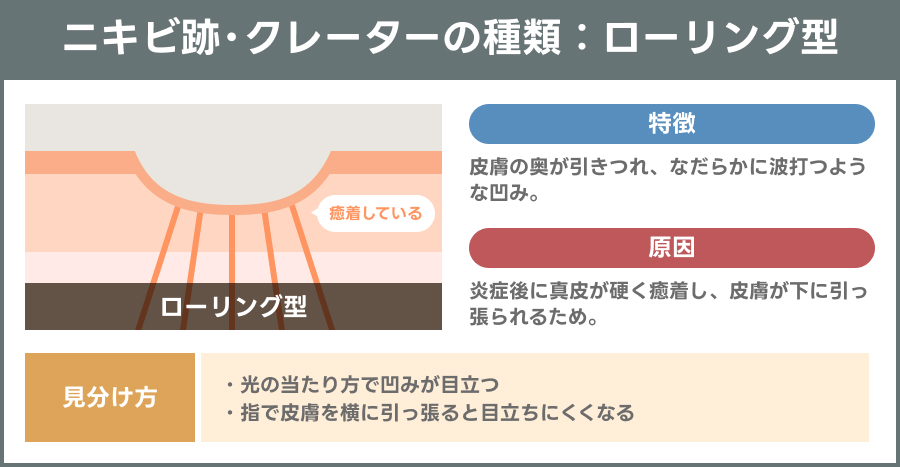
Rolling scars are characterized by large, smooth depressions. Inflammation causes tissue fibrosis, which pulls the skin downward from the dermis and creates deep depressions.
Rolling scars are the type of atrophic scar for which Subcision is most effective. The Subcision technique cuts the fibrous bands connected to the dermis from an angle and can produce significant improvement. Combining Subcision with Hyaluronic Acid Injection may further enhance the effect.
Derma Pen may be selected when the depression is shallow. However, because Derma Pen creates vertical holes, it can be difficult to cut the fibrous bands, and sufficient improvement may not be achieved.
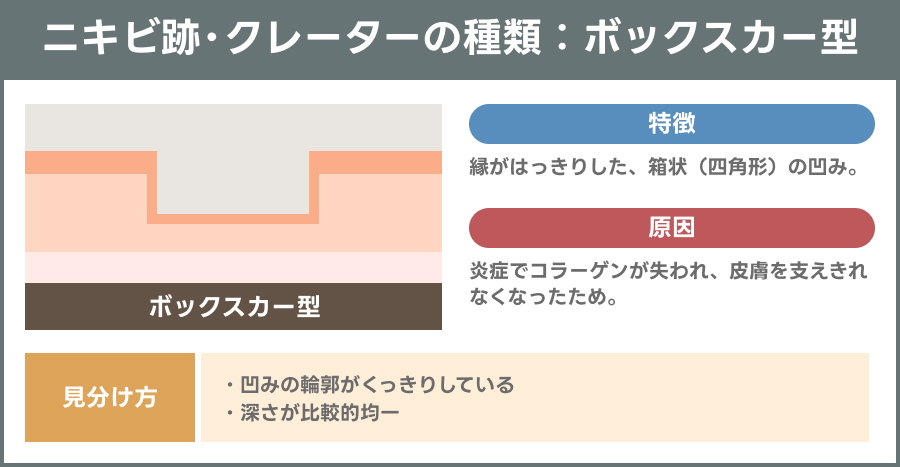
Boxcar scars vary in size but are characterized by nearly vertical depressions with flat bottoms. The vertical depressions form when acne scars beneath the skin become hardened.
The treatment selected for boxcar scars depends on their depth. When the scar is deep, Subcision can be effective for cutting the hardened tissue beneath the bottom of the depression. When it is shallow, treatments that activate the skin, such as Derma Pen or Peeling, may be effective.
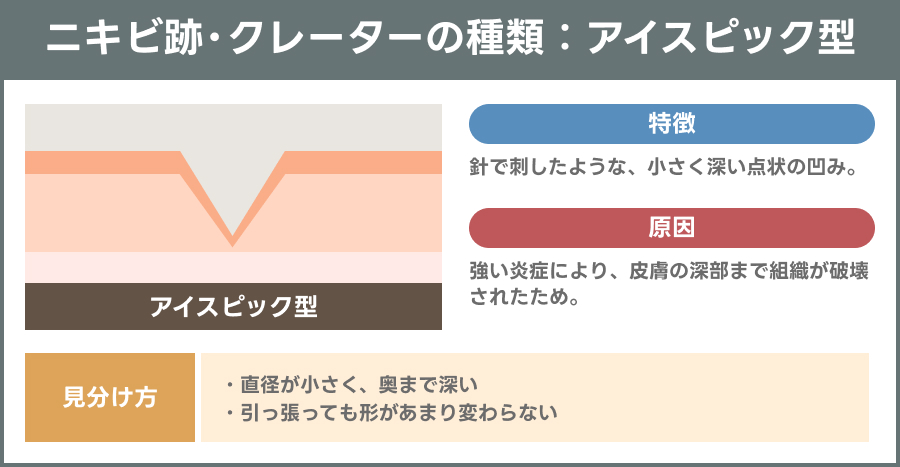
As the name suggests, ice-pick scars are narrow and deep, resembling a puncture made by an ice pick, and extend deeper than the dermis. They are formed when scar tissue extending below the dermis becomes hardened, making them difficult to treat with Subcision.
Ice-pick scars are considered the most difficult type of atrophic scar to improve. The hardened scar tissue must be removed and the tissue reconstructed. Recommended treatments include Derma Pen and Pico Fractional Laser. Derma Pen uses longer needles, while Pico Fractional Laser delivers energy deeper into the skin, creating deeper-than-usual openings and stimulating skin regeneration while breaking down hardened tissue.
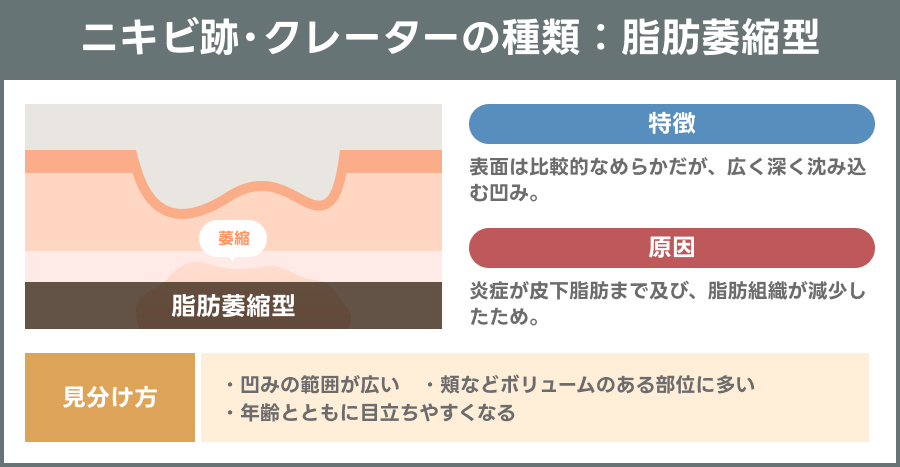
Lipoatrophic scars form when severe inflammation caused by acne extends beyond the dermis into the underlying subcutaneous fat. When inflammation reaches the subcutaneous fat, fibrosis occurs and pulls the skin inward. The skin may also become deeply depressed as the skin and fat harden.
Lipoatrophic scars often contain a mixture of rolling, boxcar, and ice-pick scars. Therefore, improvement generally requires combining treatments such as Hyaluronic Acid Injection with Subcision.
Subcutaneous fat also tends to decrease with age. As a result, acne scars that were not noticeable when you were younger may become more visible over time.
The most suitable treatment differs depending on the type of acne scar. Here, we also introduce the main treatments other than Subcision. In some cases, combining treatments may lead to better results, so they may also be considered together.
Derma Pen is a treatment that promotes skin regeneration by using a medical device with ultra-fine needles to create many tiny holes in the skin. The major difference from Subcision is that Derma Pen provides uniform stimulation to the shallow layers from the epidermis to the dermis. In contrast, Subcision directly addresses adhesions in the subcutaneous tissue.
Derma Pen is particularly suitable for the following types of acne scars.
Derma Pen promotes skin regeneration and may improve not only acne scars but also enlarged pores and reduced skin firmness and elasticity. Its downtime is shorter than that of Subcision, and the effects gradually appear with repeated treatments. However, Subcision is often more effective for deep atrophic scars.
Hyaluronic Acid Injection is a treatment that injects highly biocompatible hyaluronic acid into depressed areas to physically lift them. While Subcision cuts adhesions, Hyaluronic Acid Injection directly fills the depression.
Hyaluronic Acid Injection is suitable for acne scars such as the following.
Hyaluronic acid is broken down in the body over time, so the effect generally lasts about 6 months to 1 year. When combined with Subcision, a synergistic effect may be expected: Subcision releases the adhesions, and hyaluronic acid fills the depression. Particularly for deep atrophic scars, the combination is often more effective than Subcision alone.
Peeling is a treatment that uses chemicals to remove old dead skin cells and the epidermis, promoting skin regeneration. TCA Cross is also a type of Peeling that applies high-concentration trichloroacetic acid (TCA) precisely to depressed areas. While Subcision addresses adhesions beneath the skin, Peeling mainly acts on the epidermis and upper dermis.
The types of acne scars suitable for Peeling are as follows.
TCA Cross is particularly effective for ice-pick scars and may improve small, hole-like depressions that Subcision alone cannot fully address. Combining Subcision with TCA Cross makes it possible to take a comprehensive approach to various types of acne scars.
However, Peeling tends to involve relatively long downtime, and redness and peeling of the skin may occur.
Fractional Laser promotes skin regeneration by delivering laser energy in a grid-like pattern and creating microscopic thermal injuries. While Subcision physically releases adhesions, Fractional Laser promotes skin remodeling through thermal energy.
Acne scars suitable for Fractional Laser have the following characteristics.
The effects and downtime differ depending on the type of laser. Generally, CO2 Fractional Laser tends to be highly effective but also involves longer downtime. Erbium YAG Laser is considered to involve shorter downtime.
When combined with Subcision, a synergistic effect may be expected: Subcision releases the adhesions beneath the skin, followed by Fractional Laser to promote regeneration of the skin's surface.
Subcision can be effective on its own, but combining it with other treatments may provide further improvement. Treatments that work well with Subcision include the following.
Here is an explanation of the synergistic effects of each combination.
Injecting hyaluronic acid after releasing the skin adhesions with Subcision can make depressions less noticeable immediately. Injecting hyaluronic acid into the space created when Subcision releases the adhesions physically lifts the depression and can create a more natural skin surface.
Hyaluronic acid is particularly effective for lipoatrophic atrophic scars because it helps compensate for lost tissue. It can also produce significant improvement in deep rolling and boxcar scars.
The combination of CO2 Laser, particularly Fractional CO2 Laser, and Subcision is offered at some clinics under names such as the “Kotaro-style acne scar eradication treatment.” After Subcision releases adhesions beneath the skin, CO2 Laser also stimulates the skin's surface, promoting more comprehensive skin regeneration.
This combination may improve depressions as well as overall skin texture and smoothness, making it suitable for people concerned about their overall skin condition in addition to atrophic scars. However, downtime tends to be relatively long.
When ice-pick acne scars are present together with other types, combining Subcision and TCA Cross can be effective. Subcision addresses rolling and boxcar depressions, while TCA Cross improves the small, hole-like depressions of ice-pick scars.
Because each treatment is effective for different types of atrophic scars, this combination allows a comprehensive approach to acne scars containing multiple types.
We will introduce cases treated with Subcision for acne scars, together with photographic before-and-after results.
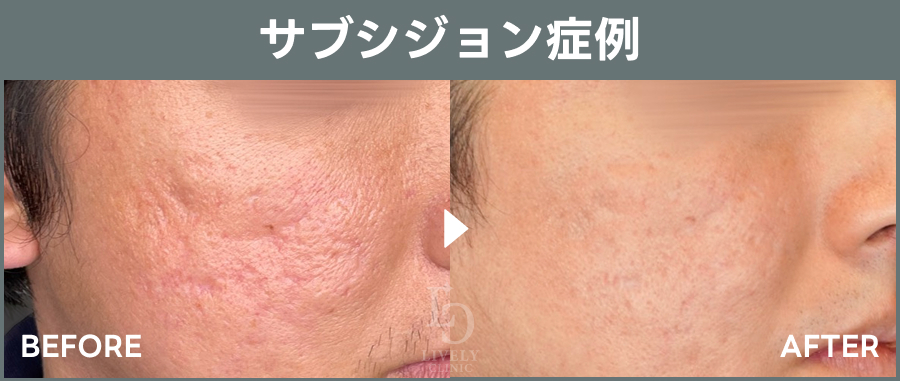
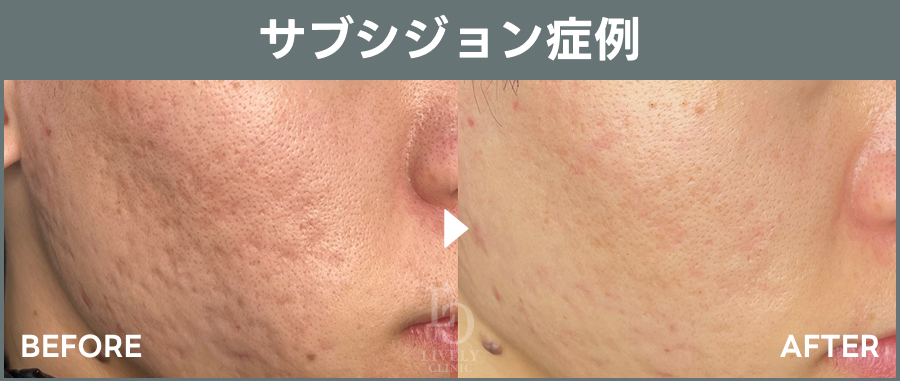
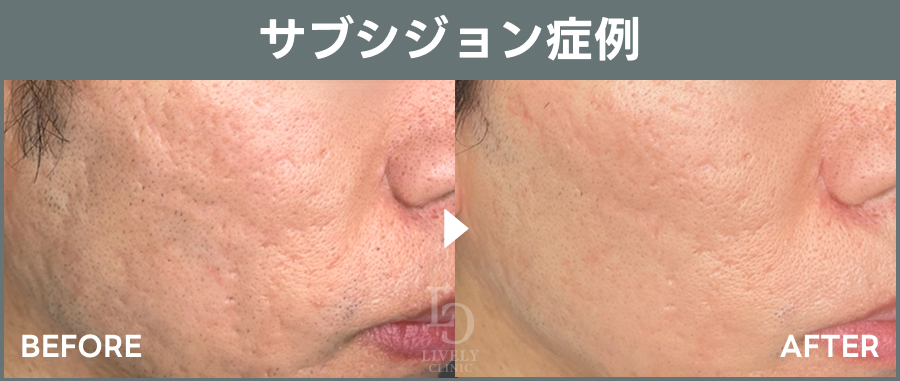
Here is an overview of the Subcision treatment process.
A consultation and examination are performed before treatment. We listen to your concerns and wishes and examine the condition of your acne scars. After checking your skin type and condition, we propose a suitable treatment plan. If you have any concerns or questions, please feel free to discuss even the smallest matter with us.
On the day of treatment, the procedure proceeds as follows.
Treatment time varies depending on the number and area of the depressions, but is generally about 15–30 minutes.
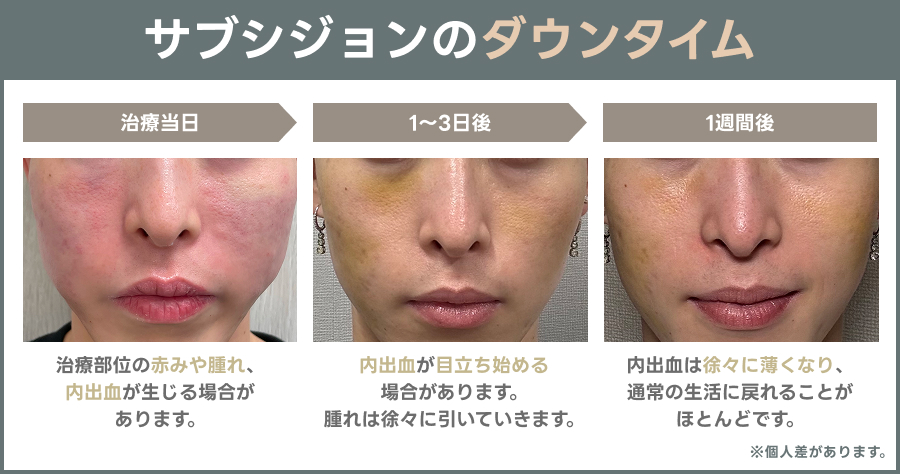
There is a certain amount of downtime (recovery time) after Subcision. The typical course of downtime and precautions are as follows.
【Day of treatment】
Redness, swelling, or bruising may occur in the treatment area. Avoid makeup and keep the area clean. Cooling the treated area may also help reduce swelling.
【1–3 days after treatment】
Bruising may begin to become noticeable in some people. Swelling gradually subsides. Light makeup is possible, but covering bruised areas may cause irritation, so take care. Avoid strenuous exercise and alcohol, as they promote circulation and may worsen bruising.
【One week after treatment】
Bruising gradually fades, and most people can return to their normal routines. However, take particular care to avoid sun exposure. Because the skin is more sensitive to ultraviolet rays after treatment, apply sunscreen and avoid direct sunlight.
Learn what to expect during Subcision downtime, from immediately after treatment through recovery, with aftercare tips based on real cases.
Immediately after Subcision, redness and swelling occur in the treated area. This is a normal reaction caused by cutting the subcutaneous tissue with a needle. Results vary from person to person, but swelling may be somewhat more noticeable when a wide area is treated or when deep atrophic scars are addressed.
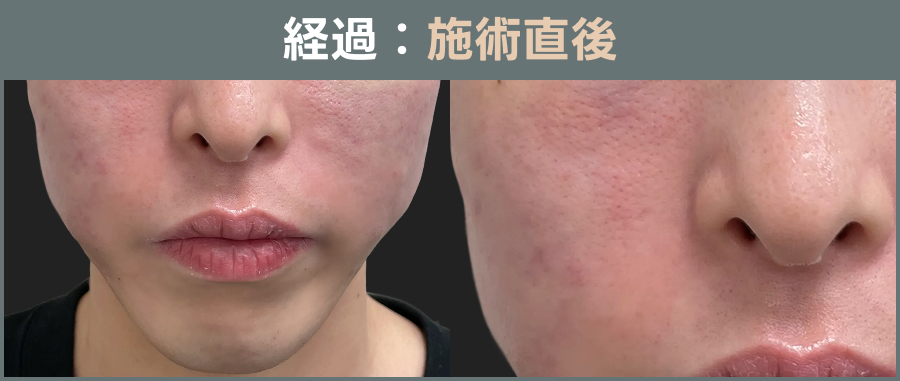
For several hours immediately after treatment, the anesthetic effect may remain, making it difficult to feel pain. As the anesthesia wears off, you may feel mild pain, stinging, or a dull ache. Pain varies from person to person, but in many cases it is not severe enough to be unbearable and settles within about 2–3 days.
【Aftercare points immediately after treatment】
You may be surprised by the change in appearance immediately after treatment, but this is temporary. Appropriate aftercare can help minimize downtime. Swelling caused by the anesthetic is quickly absorbed and settles in about 1–2 days.
After one week, swelling has subsided considerably in many people. However, bruising may be most noticeable around this time.
Bruising changes from bluish-purple to yellowish and gradually fades. This color change indicates that the body is recovering. Bruising is particularly likely after treatment of the temples and may cause a purple or yellow discoloration around the eyes for about 1–2 weeks. However, it fades naturally and is not a concern.

After one week, light makeup is possible. Light makeup that avoids the treated area is possible from the following day, but rubbing the bruised area forcefully to cover it heavily may delay healing, so take care. Limit yourself to gently applying concealer. Redness may remain around the needle entry points for about one week after treatment but gradually fades.
【Aftercare points one week after treatment】
Bruising is noticeable during this period, so it may concern people who have plans to meet others. However, bruising will eventually disappear, so it is important to continue appropriate care without rushing. Tissue damage and swelling caused by bruising generally settle within one week.
After one month, bruising has completely disappeared and swelling has fully subsided in most people. This is when you may begin to notice the effects of Subcision. New tissue forms where the adhesions were cut, and the atrophic scars become less noticeable as the skin is lifted. Collagen production is promoted in the treated areas, and skin texture may gradually become smoother over time.
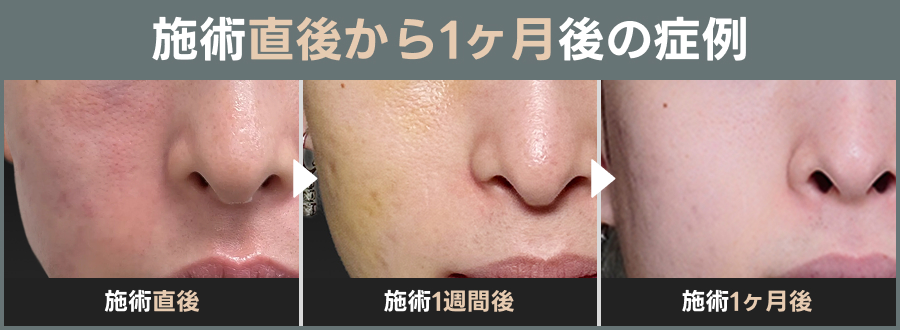
However, the effects of Subcision gradually appear over time. The skin regeneration process varies from person to person, and it may take about 3–6 months for the final effects to fully appear. Subcision is a procedure in which the skin regenerates over time rather than one that produces immediate effects, so observe changes in your skin without rushing. The period from about 1 to 3 months after treatment is when the effects may be easiest to notice.
【Aftercare points one month after treatment】
At one month, most people can resume daily life without significant difficulty and begin to feel the effects of Subcision. However, it takes time for the final results to appear, so it is important to monitor the treatment process without rushing.
Subcision is an effective treatment for acne scars, but following your physician's instructions and receiving appropriate aftercare are important for achieving the expected results. Before treatment, receive a thorough explanation and do not hesitate to consult your physician if you have any questions.
The effects of Subcision vary from person to person, but multiple treatments are generally necessary to achieve satisfactory results. The typical number and frequency of treatments are as follows.
Depending on the condition of the atrophic scars, satisfactory results are often achieved with approximately 3–5 treatments. You may feel a certain degree of improvement after the first treatment, but gradual improvement over time produces a more natural finish.
Your physician will determine the interval based on your recovery from the previous treatment, but generally an interval of about 1–3 months should be allowed. This is to allow bruising and swelling after Subcision to fully subside and to allow the tissue regeneration process to progress.
Shortening the interval in an attempt to achieve results quickly may instead prolong bruising or swelling and increase the burden on the skin. It is important to follow your physician's instructions and receive treatment at appropriate intervals.
Subcision may carry risks of side effects such as swelling, bruising, redness, pain, and puffiness. These symptoms generally begin to subside after about one week.
If swelling or redness occurs, cooling the area treated with Subcision may help the symptoms improve more quickly. Even when people receive the same treatment, results naturally vary from person to person. Please also remember that the same results are not guaranteed for everyone.
Appropriate aftercare is important to maximize the effects of Subcision and minimize side effects.
Avoid washing your face on the day of treatment, and wash gently from the following day. Avoid scrubbing or rubbing your face. It is also important to moisturize adequately after treatment to support skin recovery. Using a moisturizer recommended by your physician is best.
Because the skin is more sensitive to ultraviolet rays, apply sunscreen when going outside and avoid sun exposure. For about one week after treatment, it is best to avoid activities that promote circulation, such as saunas, hot yoga, and alcohol consumption.
Light makeup is possible from the following day, but be careful because trying to cover bruised areas heavily may cause irritation.
Subcision is effective for many people, but the following people should take particular care when considering whether treatment is appropriate.
Ask your primary physician to determine whether you can receive treatment. Before visiting the clinic, we recommend consulting the hospital where you receive treatment for any existing condition.
Subcision is particularly recommended for people with the following concerns.
Subcision is recommended for people who want to address the fundamental cause of atrophic scars, not just achieve surface-level improvement. Long-term effects may be expected rather than temporary improvement.
Subcision is an effective treatment option for many people troubled by acne-scar atrophic scars. In particular, its approach of directly releasing adhesions deep beneath the skin can be effective for deep acne scars that are difficult to address with other treatments.
It is important to understand that Subcision is a medical procedure. Be sure to receive treatment at a reliable medical institution under the care of an experienced physician. Before treatment, receive a thorough explanation, and do not hesitate to consult your physician about any questions or concerns.
Even acne scars that have troubled you for many years may improve with appropriate treatment. Use modern medical technologies, including Subcision, to achieve skin you can feel confident living with.
※For treatments other than the full-face treatment, a separate local anesthesia fee of 22,000 yen will be charged.
※Anesthetic cream (optional): ¥3,300
※Nitrous oxide anesthesia (optional): ¥8,800
※Sedation Pack / 3,300JPY
※Acne and comedone extraction / 3,300 JPY (1 area)