【Case Studies】Illustrated Guide to Subcision Failures and Their Causes|How to Choose the Right Indications and Clinic to Avoid “No Results”

Language:
Language:



BLOG
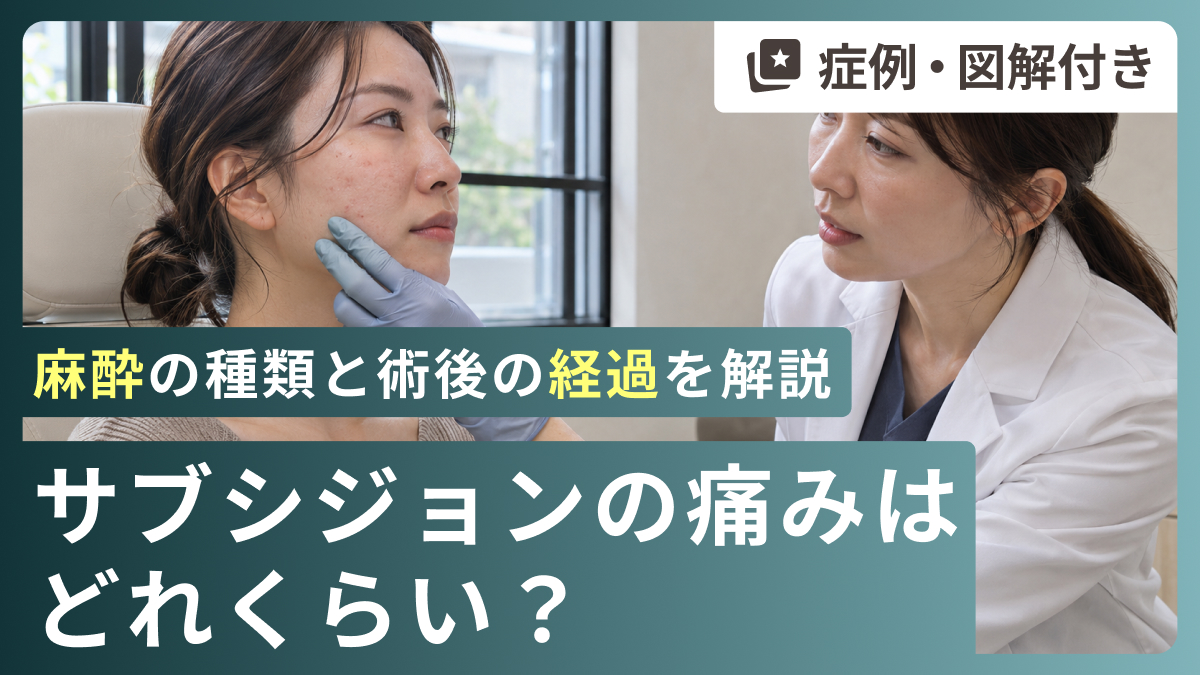
When researching ways to improve acne-scar craters, you may come across a treatment called Subcision. This treatment involves inserting a needle beneath the skin and releasing the adhesions that pull the depression down from its base. However, even if you understand that it may be effective, many people hesitate to book an appointment as soon as they hear the word “needle.” Some testimonials say it was “quite painful,” while others say it was “easier than expected.” Much of this difference comes from how the anesthesia is administered and how large an area is treated at one time.
In this article, we explain when pain may occur during Subcision and how it can be reduced, separately covering the procedure itself and the post-treatment period.








To state the conclusion first, whether Subcision is a difficult treatment depends greatly on how deeply the anesthesia takes effect. The pain is not caused simply by the needle passing through the skin. A sharp pain occurs when the needle tip touches a layer that has not been anesthetized. Because the target is the bundle of fibers beneath the dermis that holds the depression down, applying only cream-type topical anesthesia to the surface will not eliminate sensation at that depth.
Rather than asking, “Does it hurt?”, asking, “What type of anesthesia will be used, and how deeply will it take effect?” is likely to produce a much more informative answer. The former tends to lead to a discussion of individual sensitivity and pain tolerance, while the latter asks about the design of the procedure itself.
Subcision is a treatment in which a specialized needle is inserted horizontally beneath the skin and moved in a fan-like motion to release adhesions. In rolling-type craters with gently sloping edges and a broad base, adhesions caused by scar tissue develop between the dermis and subcutaneous tissue, pulling the skin inward. The reason the skin does not become flat no matter how much the surface is resurfaced is that the root causing the pulling remains beneath the skin.
Once the pulling is released, the depression rises, and new collagen is produced during the healing process in the space created by the release. It may be easier to understand Subcision as a treatment that cuts the cause of the depression rather than one that simply fills it.
Subcision is most effective for rolling-type scars. When the base is broad and the depression becomes shallower when the skin is gently pulled sideways with a finger, adhesions are considered likely to be the main cause. Boxcar-type scars with sharply vertical edges may also be suitable, depending on their depth.
By contrast, its effect is limited for ice-pick scars, which are narrow and deep like a puncture made with ice, and combination with another treatment is generally necessary. Rolling-type scars often coexist with other types in the same area, so it is common to design a treatment plan combining several treatments.
To achieve results that justify the pain and downtime, have a doctor first determine what type of depression you have.
The needles used for Subcision include sharp needles, which make it easier to cut through hard scar tissue, and cannulas, which are less likely to damage blood vessels and can help reduce bruising. They are selected according to the depth and location of the crater.
Some of these instruments have not received approval under Japan’s Pharmaceuticals and Medical Devices Act. They are obtained through personal importation and used under the responsibility and management of a physician. No domestically approved product with the same performance exists, and no reports of serious health damage have been confirmed in other countries.
The Relief System for Adverse Drug Reactions applies to pharmaceuticals and similar products, and health damage caused by medical devices is not covered. Please ask your physician about the details of the instruments used during your consultation.
The sensation during the procedure does not continue at the same intensity from beginning to end. The points at which pain tends to arise can generally be divided into the following three situations.
We explain each in detail.
This is the situation many people recall as “the most painful.” In addition to the pain when the needle enters, there is a stretching sensation as the anesthetic solution spreads through the tissue. The actual time is short, but the tension of knowing that the treatment is about to begin may make the experience particularly memorable.
Conversely, this is also the part where there is the greatest opportunity to make adjustments. How the procedure feels can change considerably depending on whether another type of anesthesia is used before the injection.
If the anesthesia is sufficiently effective, the release itself does not usually register as sharp pain. It is generally felt as vibration from the needle moving beneath the skin or pressure as the tissue is pushed apart from within. Some people describe it as a “strange sensation” rather than pain.
Problems occur when the needle moves slightly outside the area affected by the anesthesia. Touching the boundary can cause sudden pain in an area that had been numb until then. This is a situation that can be addressed with additional anesthesia, so tell the practitioner immediately rather than enduring it.
The effects of local anesthesia continue for a while after the procedure and then gradually fade over several hours. Because bruising occurs in the tissue that was released, a dull, tingling pain or a heavy, tight feeling in the cheek may appear as the anesthesia wears off.
In many cases, the pain is not severe enough to require pain medication. Depending on how the anesthesia spreads, the area around the eyes or mouth may also be difficult to move for several hours, but this too returns to normal over time. Knowing this in advance may help you calmly accept it as an expected part of the process.

There are reasons why the experience can differ from person to person even when the same treatment is performed. It is not simply a matter of individual sensitivity or pain tolerance. Specifically, pain perception is said to vary in situations such as the following.
Let us look at the details.
The deeper the crater and the longer it has been present, the thicker and harder the fibers tend to become. Releasing hard adhesions requires the needle to be moved with greater force, so the surrounding tissue also receives a proportionately greater stimulus. This is why a strong sensation of pressure may occur even when the anesthesia is fully effective.
Conversely, if the depression is shallow and the skin stretches readily when pulled, less force should be needed for the release. The required depth of anesthesia also differs depending on whether the adhesions are limited to the superficial dermis or extend into the subcutaneous tissue.
Treating only part of one cheek and treating a broad area from both cheeks to the temples require different procedure times and amounts of anesthesia. As the area expands, there is more potential for uneven anesthesia, and the burden of maintaining the same position also increases.
The extent of downtime is also generally proportional to the area treated. For the first treatment, consider limiting the area to observe the course, then expanding it while monitoring the results. For people who are particularly anxious about pain, this gradual approach can be a practical compromise.
Areas where the skin is thin and the bone is close tend to feel stimulation more strongly. The temples and areas near the eyes are more likely to transmit sensations and develop bruising than the center of the cheeks. The outer cheeks, where the subcutaneous tissue is thicker, can generally be treated more comfortably.
The reason sensations differ by site even in the same person is this structural difference. Once the treatment area has been decided during the consultation, confirming which areas are likely to feel more intense can help you prepare for the procedure.
A factor that is easily overlooked is the difference created by the practitioner’s technique. Trying to cut adhesions by force can involve the surrounding tissue and spread the stimulation. When the release is performed gradually while identifying the correct layer, the experience can be easier even when treating the same area.
The number and placement of needle entry points also vary, and these factors affect the spread of bruising. Whether the physician can select between a sharp needle and a cannula, and choose the layer to release according to the type and depth of the crater, can result in differences in pain and downtime.
Pain is not something you simply have to endure; it is a factor that can be reduced through careful planning. In practice, measures such as the following are used.
Although patients cannot directly control these factors, there are points you can confirm during your consultation. Let us take a closer look.
First, cream-type anesthesia is applied to dull sensation on the skin’s surface, followed by an injection of local anesthesia. If the surface has been anesthetized, the pain when the injection needle enters should be considerably reduced. Because time is needed for the anesthesia to take effect after application, the total procedure time will be longer.
Even so, whether or not this step is omitted can make a major difference in how the procedure feels. A method of administering anesthesia layer by layer—allowing it to take effect from the superficial layers before proceeding to deeper layers—is also becoming more widespread. This approach is designed to prevent the anesthesia itself from becoming a source of pain.
Local anesthetic solutions are acidic, and injecting them into the body, which is alkaline, can cause intense irritation in itself. For this reason, sodium bicarbonate is often added to the anesthetic solution to bring its pH closer to that of body fluids. Other considerations that can reduce pain during injection include warming the solution to approximately body temperature, slowing the injection rate, and selecting a thin needle.
These may not be dramatic measures, but they directly affect how the patient feels. At LIVELY CLINIC, we also highlight anesthetic techniques designed to minimize pain as one of the features of our treatment.
Some people endure pain because they believe speaking up would inconvenience the practitioner. However, for the practitioner, reporting pain is important information indicating an area that has not been adequately anesthetized.
If you tell the practitioner, additional anesthesia can be administered, but there is no way to notice the problem if you remain silent. Tensing your body to endure pain also tightens the skin, making it more difficult to manipulate the needle. To allow the procedure to proceed calmly, tell the practitioner what you are feeling at the time. This may also have a positive effect on the final result.
Post-treatment pain is not constant. It generally becomes milder in stages from the day of treatment through approximately one week. We explain the course of pain from the day of treatment through after the first week.
After the anesthesia wears off, the main sensations are dull, tingling pain and a heavy, tight feeling in the cheeks. Because swelling and bruising occur at the same time, you may be surprised by the visible changes when you look in the mirror. These symptoms generally settle as you cool the area and rest.
Most people do not need pain medication, but oral medication may be prescribed if the pain is strong. Follow the prescribed instructions and do not add over-the-counter medication based on your own judgment.
The pain generally decreases to the point that you do not feel it when resting, then shifts to mild discomfort when washing your face or moving your facial muscles. During this period, bruising is usually more noticeable than pain. It generally fades over approximately 3–5 days, changing from bluish-purple to yellow.
As a lifestyle restriction, the basic approach is to avoid activities that significantly increase blood flow. Avoid long, hot baths, strenuous exercise, and alcohol for a while.
There are almost no situations in daily life in which you remain aware of the pain. A slight unusual sensation when pressing the area or a feeling of hardness beneath the skin may continue for some time, but these are part of the healing process and gradually ease over several weeks to several months.
From this point onward, new collagen is produced in the areas that were released. The appearance of the depressions begins to change after the pain has subsided, so follow the progress without rushing.
The key to faster recovery comes down to two points: not increasing blood flow excessively and not irritating the treated area. For approximately 48 to 72 hours after treatment, avoid strenuous exercise, saunas, and long baths, and refrain from alcohol for 2–3 days. Increased blood flow can make bruising more likely to spread and can intensify throbbing pain.
Wash your face and apply skincare products without rubbing, and ask the clinic when you may resume massages involving vigorous movement. If you tend to sleep on your stomach, you will also need to take care not to put pressure on the treated area.
In addition, refraining from supplements that affect blood flow, such as fish oil and vitamin E, for 1–2 weeks before treatment may in some cases reduce bruising.

It is easy to focus only on pain, but other symptoms may have a greater impact on daily life. Here are some typical symptoms during downtime.
You should assume that bruising will occur in almost everyone. It appears bluish-purple the following day and generally becomes much less noticeable after about one week as its color changes.
However, it may remain for 2–3 weeks when a large area is treated or when the treatment site has many blood vessels, such as the temples. Swelling peaks on the day of treatment or within several days, then gradually subsides.
If you are undergoing treatment, avoid scheduling it immediately before an important event and allow yourself plenty of time. Simply avoiding periods when you have many opportunities to meet people can significantly reduce the psychological burden.
Another point to keep in mind is hyperpigmentation. Brownish discoloration may rarely remain after bruising or inflammation. Because exposure to ultraviolet light can make it more likely to become established, be sure to apply sunscreen after treatment.
In many cases, it naturally disappears over several weeks to approximately six months, but light-based treatment or laser treatment may also be used if you want to improve it more quickly. If the discoloration persists for a long time and concerns you, do not hesitate to tell your physician.
When treating acne scars, the basic approach is to choose a treatment based not on how little it hurts, but on which layer it targets. Let us look at treatments other than Subcision.
Devices combining microneedling with radiofrequency apply heat to the dermis to promote collagen production and improve the overall quality of the skin. Because they work toward smoothing unevenness, they may be used in combination with Subcision in the order of releasing deep adhesions with Subcision and then improving the superficial layers.
Devices intended to release adhesions have also appeared, but the depth they target and the precision of the release differ. Rather than viewing this as a choice between one or the other, consider it a matter of each treatment’s role and sequence.
Injecting hyaluronic acid or your own fat is based on the idea of physically filling the depressed space. While this has the advantage of producing visible changes quickly, if the fibers causing the pulling remain, the area is more likely to return to its original state over time. Combining an injection with Subcision after releasing the adhesions may also help prevent the space created by the release from adhering again.
A treatment that addresses the cause and a treatment that improves the shape are not mutually exclusive. Confirm the type and cause of the depression during your consultation, then determine the treatment sequence.
Here are common questions about pain, along with points to understand before your consultation.
It is true that pain perception varies from person to person, but the range of options available can be expanded depending on the anesthesia plan. If you tell the clinic in advance that you are very anxious, you may be able to discuss adjustments such as using a more thorough anesthesia process or limiting the treatment area so the procedure can be completed in a shorter time.
The approach to avoid most is arriving on the day without saying anything and then simply enduring the pain. Even adding a brief note to the medical questionnaire when you make your appointment can change how you are accommodated on the day.
In terms of pain, most people can work as usual from the following day. However, bruising and swelling remain for about one week, so it may be reassuring to avoid periods when you have many plans involving other people.
Whether the treated area can be covered by a mask is also a factor when deciding your schedule. Many people book their appointment the day before a holiday period so they can allow several days for the discoloration to fade.
In general, a course of approximately 3–5 treatments spaced 4–6 weeks apart is considered a guideline, although some people notice changes after just one treatment.
At LIVELY CLINIC, many patients experience noticeable results even after a single treatment, which we consider one of the features of our treatment. The number of treatments needed varies depending on the depth and extent of the depressions, so please have your skin assessed before making a decision.
If you have previously experienced anesthesia not working well, tell the doctor the details as specifically as possible. Knowing which treatment you had, when it took place, and how the anesthesia worked will help the doctor decide how to adjust the amount and method of administration.
The more you hold back when reporting your experience, the narrower your options for responding become. Even if the anesthesia feels insufficient during the procedure, there may still be room to administer additional anesthesia. Please do not hesitate to discuss this with your doctor during your consultation.
Subcision treatment at LIVELY CLINIC has the following features.
Here, we explain how our clinic performs Subcision, including our consideration for patient comfort.
Subcision does not produce the same results at every clinic. Decisions about which layer to release adhesions from and how extensively to release them directly affect the final result.
At our clinic, experienced physicians perform the treatment, and many patients notice changes in their skin after a single procedure. Another feature is that we select the needle according to the treatment area and the condition of the craters, taking steps to achieve results with each treatment. After carefully examining your skin, the physician will recommend a treatment plan tailored to you.
Many people hesitate to book an appointment because they are anxious about pain. Our physicians also focus on anesthetic techniques and take care to minimize pain during the procedure. We have a system that makes treatment more accessible to people who are sensitive to pain or who are undergoing Subcision for the first time.
We also generally use cannulas with non-sharp tips. Because they are less likely to damage blood vessels, they can help reduce the risk of bruising after treatment. Consider this an approach designed to reduce the burden from both pain and downtime.
When craters cover a large area, the cost of one treatment can become high depending on the procedure. At our clinic, we set a maximum price, so even people concerned about extensive areas do not have to give up on treatment. We also offer menus that can be taken in smaller amounts for those who want to try treating only part of the depressions.
In addition, injecting hyaluronic acid at the same time as Subcision may help prevent re-adhesion beneath the skin while lifting the skin. Please discuss costs and treatment combinations during your consultation.
During Subcision, if the anesthesia is effective, the main sensation is pressure rather than sharp pain. Dull pain may occur several hours later as the anesthesia wears off, but in many cases it subsides within a few days without requiring pain medication.
In terms of the impact on daily life, bruising that becomes less noticeable in about one week may be a more practical consideration. If you want to reduce anxiety about pain, confirm in advance how the anesthesia will be administered and how large an area will be treated at one time.
At LIVELY CLINIC, our features include anesthetic techniques designed to minimize pain and pricing that accommodates treatment of extensive crater areas. Start with a free consultation to discuss your skin condition and treatment plan.
※For treatments other than the full-face treatment, a separate local anesthesia fee of 22,000 yen will be charged.
※Anesthetic cream (optional): ¥3,300
※Nitrous oxide anesthesia (optional): ¥8,800
※Sedation Pack / 3,300JPY
※Acne and comedone extraction / 3,300 JPY (1 area)