


Quantum RF Disadvantages and Precautions | What You Should Know to Avoid Regret

Language:
Language:



BLOG

“Quantum RF,” which is attracting attention as a non-surgical treatment for sagging, is an advanced aesthetic treatment that delivers fractional RF (radio-frequency) energy from inside the skin to significantly tighten sagging skin on the face and body. Even though the treatment does not use a scalpel, you may be concerned about the length and symptoms of the downtime.
This article provides a detailed explanation of the expected downtime for Quantum RF, the recovery process by day, possible side effects, and important points for aftercare. If you are considering Quantum RF treatment, please use this article as a reference.





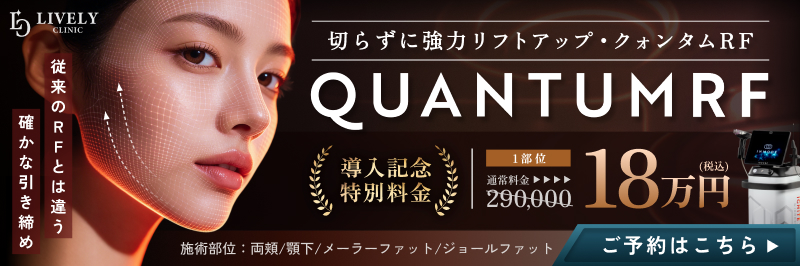


Quantum is a treatment that uses a device called “Ignite RF” to directly deliver fractional RF (radio-frequency) energy to the subcutaneous tissue to treat sagging. High-frequency energy is emitted in eight directions from the tip, instantly contracting the FSN (Fibrous Septal Network), which contributes to sagging, to achieve a powerful lifting effect.
Unlike conventional facelift surgery, it does not require large incisions with a scalpel. Instead, it approaches the tissue through a tiny opening approximately the size of a needle hole, making scars less noticeable. It can address sagging not only on the face but also on areas of the body such as the upper arms, abdomen, and thighs. Combination treatment with Full body liposuction or Thread lift is also considered possible.
The main characteristic of Quantum is that it delivers high-frequency energy from inside the skin rather than from its surface. Fractional RF electrodes fitted to the tip of the handpiece apply heat energy from the dermal layer through the subcutaneous fat layer. Specifically, high-density RF is delivered in 360° directions from the tip of an ultra-fine 2.2-mm-diameter cannula. The area within 1 mm around the cannula reaches a maximum temperature of 100°C, and this heat is expected to promote the contraction and regeneration of collagen fibers while also destroying excess fat cells.
Two types of handpieces are used depending on the treatment area: a facial handpiece (10 cm) and a body handpiece (25 cm). This allows precise treatment of small areas such as nasolabial folds and the area under the chin. Another appealing feature is that the treatment can tighten the area evenly as a whole, potentially producing a natural-looking result.
Quantum is expected to improve sagging and provide lifting, a smaller-face effect, improved skin quality, and improvement in nasolabial folds. By contracting the FSN, it tightens laxity along the facial line and under the chin while reducing excess fat to create a more defined contour.
Increased collagen production can also improve skin firmness and elasticity, although swelling caused by anesthesia-related edema and heat is likely to be seen immediately after treatment. It is said that the effects become more pronounced as collagen regeneration progresses over the following 3–6 months. The duration of the effects varies from person to person, but the internal approach is said to make tightening easier to notice over time and allow the effects to last relatively longer.

Because Quantum RF does not involve incisions, its downtime tends to be significantly shorter than that of facelift surgery. The general guideline is approximately 1–2 weeks, although it may take around 1–3 months for the swelling to completely subside and the final results to become visible.
On the day of treatment, swelling and edema are noticeable across the face, partly due to the effects of local anesthesia. You may also experience a dull ache or warmth, but in most cases these symptoms can be managed with the prescribed pain medication. Swelling often peaks from the following day through day 3, and some people may also develop bruising.
Because this is also the period when wearing a face band (compression band) is recommended, it is best to avoid plans that require you to be around other people whenever possible. Face washing and makeup can generally be resumed 48 hours after treatment. During this period, rest as much as possible and take care not to touch the treated area.
From day 4 onward, swelling and bruising gradually begin to settle. If bruising occurs, it will fade while changing to a yellowish color, and many people find that it can be concealed with concealer.
After one week, it is generally possible to return to a state where daily life is almost unaffected. However, you may feel tightness or hardness (contracture) in the treated area, which is considered a normal reaction occurring as the tissue repairs and is reconstructed. Light exercise can be resumed from this point, but it is safer to continue avoiding strenuous exercise for a little longer.
After two weeks, visible downtime has almost completely resolved. Most traces of swelling and bruising have disappeared, and this is when many people begin to notice tightening along the facial contour compared with before treatment. Tightness caused by contracture may continue for approximately 1–3 months, but it gradually becomes softer.
This is also the period when collagen production progresses, so you may feel your skin becoming firmer and more elastic as time passes. By around one month, most people are able to clearly feel the effects of the treatment.

Quantum is considered a relatively safe treatment, but as it is a medical procedure, certain risks exist. Specifically, the following side effects and risks may occur.
Understanding the possible side effects in advance should help reduce anxiety after treatment.
Swelling and edema are the symptoms most commonly seen after treatment. They usually peak from immediately after treatment through the first three days and then gradually subside. Properly wearing a compression band and applying ice can help alleviate the symptoms. The extent of swelling varies from person to person, but in most cases it becomes less noticeable after approximately one week.
The swelling should settle to a degree that can be concealed with a mask or face band when going out. If the swelling persists or suddenly worsens, we recommend consulting your treating physician.
Because the treatment involves approaching the subcutaneous tissue, bruising may occur. Even when it does occur, it generally resolves naturally within approximately 1–2 weeks. If you take medications or supplements with antiplatelet effects, such as fish oil or vitamin E, before treatment, your risk of bleeding may be higher, so it is advisable to consult your treating physician in advance.
If you tend to bruise easily, we recommend allowing plenty of time in your schedule after treatment. In most cases, bruising can be concealed with makeup, but if it concerns you, it may be better to avoid going out.
The tightness or hardness felt after treatment is called “contracture” and is a reaction that occurs as the subcutaneous tissue repairs and contracts. Although it may feel uncomfortable, it can also be a sign that the tissue is becoming tighter.
It is generally said to gradually improve over 1–3 months. Follow your treating physician’s instructions regarding massage and other care. Trying to massage the area forcefully may instead delay recovery. If the contracture concerns you, consider receiving aftercare at the clinic.
Because local anesthesia is used during treatment, most people experience little severe pain. After treatment, a dull ache or sensation similar to muscle soreness may continue for several days, but it is generally within a range that can be adequately controlled with the prescribed pain medication.
The way pain is experienced varies from person to person, so if you are concerned, it may be helpful to ask about the type of anesthesia and measures for managing post-treatment pain during your consultation. If the pain is severe or continues for an extended period, we recommend consulting your treating physician.
Because the treatment uses heat energy from radio-frequency waves, there is a rare risk of burns. Having an experienced physician perform the treatment with an appropriate energy setting can minimize this risk. When choosing a clinic, check the physician’s experience and number of cases, and ask about safety measures during treatment at your consultation.
If pain, redness, blisters, or other symptoms occur, contact the clinic promptly. Receiving appropriate treatment can reduce the risk of lasting marks.
In very rare cases, temporary numbness or reduced sensation may occur around the treatment area. These symptoms are usually temporary, and in most cases recovery occurs within several weeks to several months. If concerning symptoms persist, promptly consult the clinic where you received treatment.
It is important to carefully monitor your recovery after treatment and address any abnormalities as soon as possible. Receiving treatment from an experienced physician is also important for minimizing the risk of nerve damage.
How you spend your time after treatment is important for shortening downtime and maximizing the treatment results. The following aftercare measures are specifically recommended.
Follow your treating physician’s instructions and take note of the following points.
In most cases, you will be instructed to wear a compression band (face band) after treatment. Wearing it for 48 hours or longer is generally recommended, as it can help reduce swelling and promote close adherence of the skin. Wearing it for as long as possible, including while sleeping, may help your recovery progress more smoothly.
It is also important to choose the appropriate size so that the band does not slip. If you experience discomfort or pain while wearing it, we recommend consulting your treating physician so that it can be adjusted.
Face washing and makeup can generally be resumed 48 hours after treatment. However, avoid rubbing the treated area vigorously or using highly irritating cosmetics, and take care to treat the area gently.
Regarding bathing, it is advisable to limit yourself to a shower on the day of treatment and avoid long baths and saunas for 1–2 weeks. This is because an increase in body temperature may worsen swelling. Keep the treated area clean while taking care not to irritate it.
Strenuous exercise and alcohol promote blood circulation and can worsen swelling and bruising. Avoid exercise for 48 hours after treatment, and continue to limit yourself to light exercise for 1–2 weeks afterward. Similarly, avoiding alcohol for at least several days is recommended. Prioritize your recovery and gradually return to your daily routine at a comfortable pace.
When resuming exercise, start with light activities such as walking and gradually increase the intensity.
Because the skin is delicate after treatment, it is more susceptible to damage from ultraviolet rays. When going outside, apply sunscreen thoroughly and take sufficient sun-protection measures, such as wearing a hat or using a parasol. Particular care is needed for approximately one month after treatment to help reduce the risk of hyperpigmentation.
Making sun protection part of your daily routine can also help your skin recover more smoothly. Even indoors, be mindful of ultraviolet rays entering through windows and make a habit of using sunscreen.
When considering Quantum RF, you may also be interested in how its downtime differs from that of other treatments for sagging. Let’s compare it with several representative treatments.
HIFU is a treatment that applies heat to the SMAS layer using ultrasonic energy, and it is generally considered to have almost no downtime.
A major advantage is that makeup can be applied immediately after treatment, allowing you to return to your daily life right away. In contrast, although Quantum RF may provide a more powerful tightening effect than HIFU, it requires approximately 1–2 weeks of downtime.
HIFU may be suitable for people with mild sagging or those who cannot take time off for downtime, while Quantum may be suitable for those seeking more substantial lifting.
Thread lift is a treatment that physically lifts the skin by inserting specialized threads beneath the skin, with downtime of approximately 1–2 weeks.
Its downtime is nearly equivalent to that of Quantum, but the mechanisms of action differ. Thread lift offers a strong immediate lifting effect, whereas Quantum is characterized by its ability to tighten the entire treatment area evenly. Increasingly, the two treatments are being combined to take advantage of their respective characteristics, and combination treatment may be an option for those seeking a greater lifting effect.
Facelift surgery is the most powerful treatment for sagging, but its downtime is longer at 2–4 weeks, and there is also a risk of scarring. General anesthesia may be required in some cases, making it a treatment that places a greater burden on the body.
Because Quantum requires no incisions and leaves little visible scarring, it may be a suitable option for people who want significant tightening but do not want surgery. It is important to choose the treatment that suits you while considering the downtime and physical burden involved.

When considering Quantum treatment, it is necessary to understand several important points in advance. Specifically, there are the following three points.
Each point is explained in detail below.
People who are pregnant or breastfeeding, those with an infection or inflammation in the treatment area, and those with metal inside the body, such as a pacemaker, generally cannot receive the treatment. Treatment may also be restricted for people with severe diabetes, heart disease, or a tendency to develop keloids.
Treatment may be difficult depending on any pre-existing conditions or medications you are taking, so it is important to accurately inform your treating physician during the consultation. Do not make this decision on your own; be sure to consult a physician before considering treatment.
Ignite RF, the device used for Quantum, is an unapproved medical device that has not received approval from Japan’s Ministry of Health, Labour and Welfare. Although it has an established track record overseas, official evaluations of its safety and efficacy in Japan have not yet been established.
Before receiving treatment, you need to fully understand the risks of using an unapproved device. During your consultation, receive an explanation that the device is unapproved and proceed with treatment only after you are satisfied with your decision.
Because Quantum is a relatively new treatment, the number of clinics offering it remains limited. Carefully assess the physician’s experience with RF devices, number of cases, thoroughness of the consultation, and aftercare system as a whole. Choosing a clinic you can trust is an important first step toward achieving satisfactory results.
We also recommend consulting with multiple clinics and comparing your options. Consider not only the price but also the physician’s technical skill and attentiveness when making your choice.
Quantum is an advanced fractional RF treatment that may provide a powerful improvement in sagging without the need for incisions. Downtime is generally approximately 1–2 weeks, with swelling and bruising being the main symptoms. Compared with facelift surgery, it allows a return to daily life after a significantly shorter recovery period.
Following post-treatment instructions, such as wearing a compression band and restricting face washing, makeup, exercise, and alcohol, can help minimize downtime while maximizing the treatment results. Understand that the treatment uses an unapproved device, choose a reliable clinic with experienced physicians, and undergo treatment only after receiving a satisfactory consultation.
※Implementation Clinics: Osaka Clinic
※Implementation Clinics: Osaka Clinic
※Implementation Clinics: Osaka Clinic
※Implementation Clinics: Osaka Clinic
※Implementation Clinics: Osaka Clinic
*Basic set (consumables, local anesthetic, oral medication) ¥110,000
Compression band (face) ¥5,500
Compression band (body) ¥16,500


