Can ONDA Lift Slim the Upper Arms? A Clinic Explains the Number of Sessions and Cost for Results

Language:
Language:



BLOG
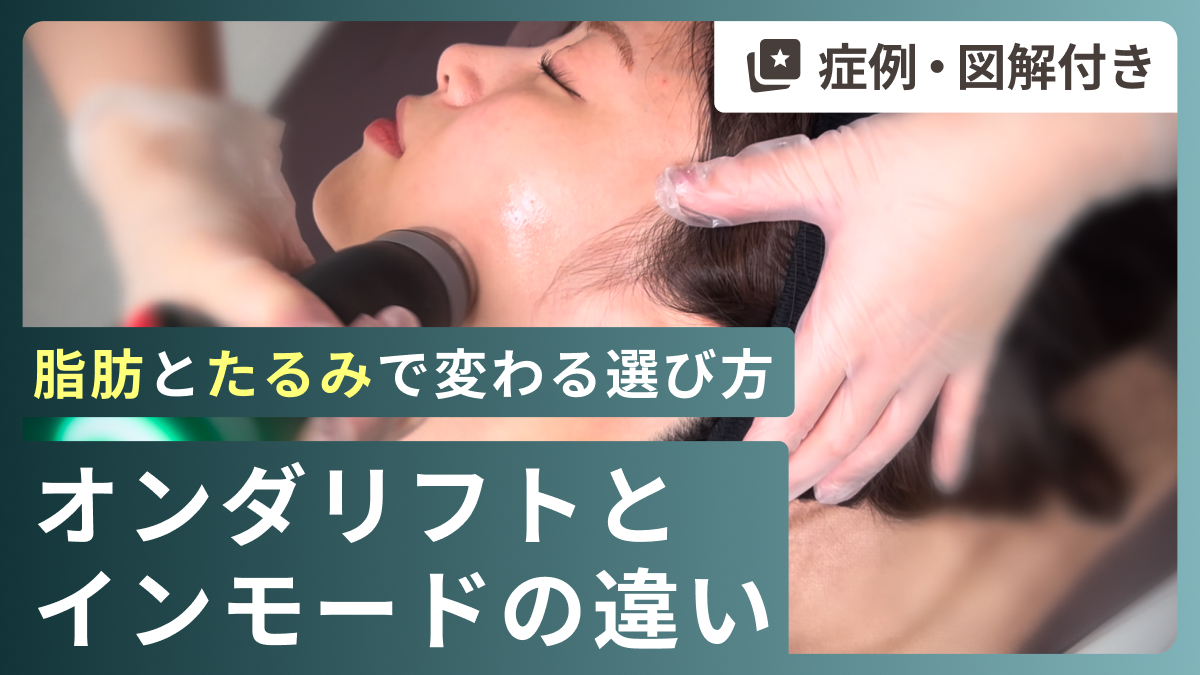
When you start researching how to improve a poorly defined facial contour, you are likely to come across two names: ONDA Lift and InMode Lift. Both are introduced as treatments that shape the contours without incisions, and their descriptions often feature similar terms such as “fat,” “sagging,” and “tightening,” which can make their differences difficult to understand. In conclusion, the two treatments differ fundamentally in how they deliver heat, and that difference directly determines which concerns they are best suited to address.
This article explains everything from how ONDA Lift and InMode Lift work to pain, downtime, and considerations for combining the two treatments.
Please note that ONDA Lift (ONDA Pro) and InMode Lift introduced in this article are medical devices that have not been approved under Japan’s Pharmaceuticals and Medical Devices Act. Both devices have been approved by the U.S. FDA, but risks including redness, swelling, a sensation of heat, and bruising have been reported. Even if a serious adverse reaction occurs, the treatment is not covered by Japan’s Relief System for Sufferers from Adverse Drug Reactions.










ONDA Lift is a treatment performed using ONDA Pro, a device developed by the Italian company DEKA. It has two effects: it works on subcutaneous fat using microwave heat while also promoting collagen production in the dermis. After gaining popularity in Korea, it has increasingly been introduced by clinics in Japan as an option for facial contouring.
It is chosen by people who want to improve fullness under the chin and a poorly defined facial contour without incisions. It can be applied not only to the face but also to areas such as the upper arms and abdomen. For more information, please refer to the article below.
Microwaves in the 2.45 GHz frequency band tend to act selectively on the subcutaneous fat layer, which is rich in lipids, rather than the dermis, which contains more water. The treatment is designed to deliver energy to the deeper fat layer while cooling the skin’s surface, thereby suppressing increases in surface temperature. It vibrates water molecules and delivers energy to deeper layers without making the skin’s surface excessively hot.
As a result, it can work directly on fullness under the chin without causing severe pain or prolonged downtime. Heated fat cells are metabolized and eliminated over time, and because the number of cells decreases, the changes are less likely to return as long as body weight does not change significantly. Heat transmitted to the dermis also promotes collagen production, making it easier to avoid a situation in which excess skin appears lax after fat has been reduced.
During the treatment, the main sensation is a gentle warmth. Because the surface is cooled, there are very few situations in which you need to tolerate intense heat, making this a treatment that may be easier to consider for people who are sensitive to pain. Downtime is also minimal; redness immediately after treatment settles within a short time, and makeup can be applied from the same day.
If you want to achieve a clearly noticeable change in the appearance of your contours, it is generally recommended to have approximately 3–5 treatments at intervals of 3–4 weeks. Because fat metabolism takes time, some people say that changes are easier to notice about one month after treatment than immediately afterward.
InMode is a radiofrequency medical device developed by the Israeli company InMode. For facial treatments, Mini FX, which works on the fat layer, and Forma, which is responsible for tightening the skin, are used. A treatment combining the two is called InMode Lift, and LIVELY CLINIC also provides it in this format. For more information about pain associated with InMode, please also refer to the article below.
Mini FX applies two types of radiofrequency while the skin and subcutaneous fat are suctioned and held between the applicator. Forma continuously warms the dermis at a constant temperature without suction. This method concentrates heat only in the area that is held.
This combination aims to reduce fat volume and improve the skin’s sense of firmness in a single treatment. Because a narrow area can be selected for treatment, it may also make pinpoint adjustments easier, such as to a very limited area beside the mouth or under the chin. On the other hand, the amount of pressure used to grasp the area and the speed at which the applicator is moved are more likely to affect the outcome, meaning that results may vary more depending on the practitioner.
Although how pain is perceived varies from person to person, many people report that the combination of suction and heat makes the stimulation feel relatively strong. Even so, it rarely becomes intolerable, and the treatment is usually performed while adjusting the energy level. Redness or mild bruising may occur in areas that were suctioned, but in many cases these become less noticeable within several days to approximately one week.
The recommended number of treatments is approximately 3–6, at intervals of 2–4 weeks. A common approach is to have the first three treatments at relatively short intervals, then move to maintenance treatments once every 3–6 months. Because effects involving changes in collagen appear over several months, it is advisable not to judge the treatment based only on the results of a single session.
Both treatments work on fat and skin tightening. Because their intended goals are similar, their differences can be difficult to see. The key distinctions are how heat is delivered and the resulting differences in sensation during treatment and downtime. Let’s take a closer look.
ONDA Lift uses microwaves, while InMode Lift uses radiofrequency. The former generates heat by directly vibrating water molecules, while the latter generates heat through the electrical resistance of tissue. Their delivery methods are also contrasting: ONDA Lift sends heat into deeper layers while cooling the surface, whereas InMode Lift concentrates heat in the area grasped by suction.
This difference appears in three areas: the sensation during treatment, the way downtime develops, and the extent to which the practitioner’s technique affects the results. Even if the mechanisms seem abstract, they ultimately affect how the treatment feels in practice.
Continuing to compare device specifications may not provide an answer. If you want to make a decision more quickly, it may be more helpful to determine whether the cause of the poorly defined contour is the thickness of the subcutaneous fat or laxity of the skin and supporting tissues.
When you lightly tuck your chin in front of a mirror, if a thick bulge appears under the chin, fat is likely to have a significant effect. Conversely, if your contour looks more defined when you look upward but the line becomes blurred when you return to facing forward, sagging may be a stronger factor. The reason people feel that the result was “different from what they expected” is often a mismatch in the initial assessment rather than insufficient device performance.
The main points are as follows.
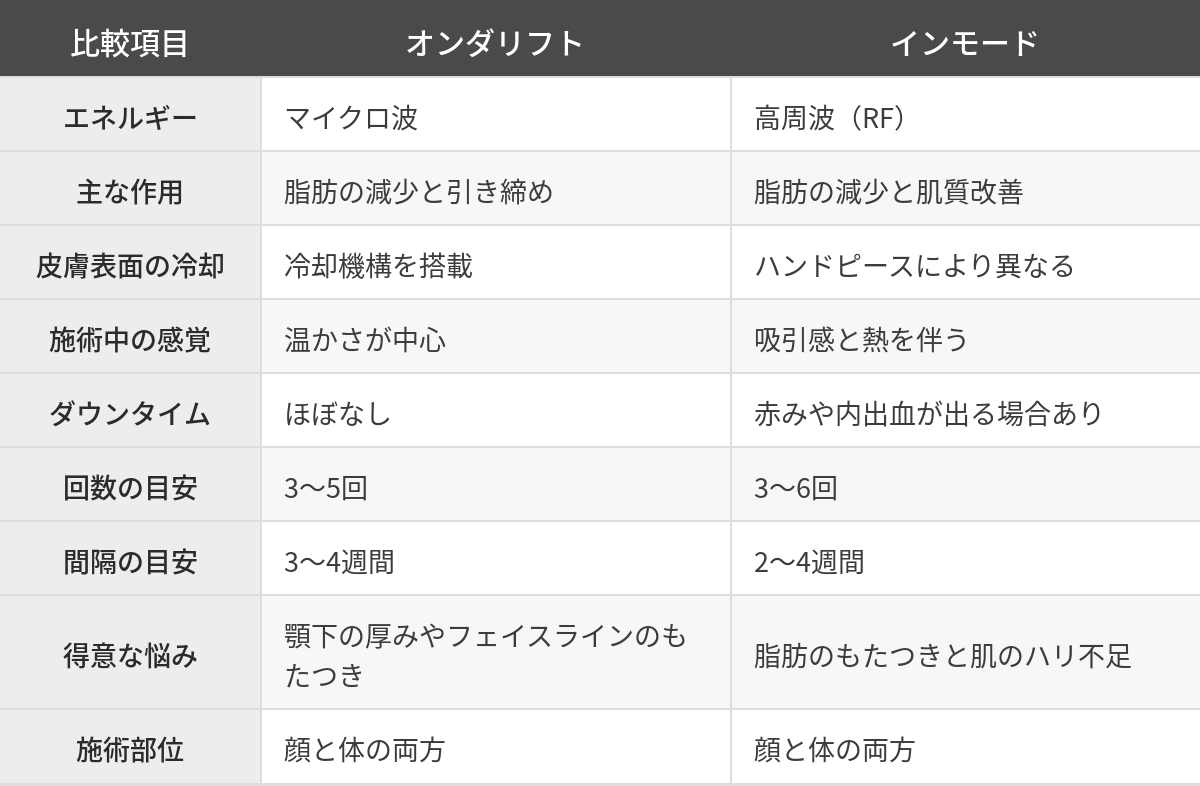
When placed side by side, the recommended number of treatments, intervals, and treatment areas do not differ significantly. The clearest differences are in surface cooling, the sensation during treatment, and downtime.
In other words, these are not treatments with entirely different purposes. Their intended goals are similar, but the methods used to reach those goals differ. Rather than comparing which is superior, choose based on which method is more compatible with your condition.
Costs vary depending on the treatment area and each clinic’s pricing system. Rather than comparing the cost per session, it may be less likely to lead to a mistaken decision if you consider the total cost—how many treatments are needed and how much they will cost for the same concern.

ONDA Lift may be a good match when fullness under the chin is the main cause, while InMode Lift may be a better match if you also want to improve skin texture. Let’s look at the specific conditions for which each may be suitable.
It is suitable for people with clearly noticeable fullness under the chin who want to prioritize reducing fat. It may also be an easy option to consider for people who are particularly concerned about pain or who cannot afford downtime because they have plans to meet people the next day. If you want to improve areas of concern on the body as well as the face, an advantage is that different handpieces can be used to address those areas.
However, applying excessive energy to an area that originally contains little fat may lead to unintended volume reduction. How areas where you want to preserve fullness, such as the upper cheeks, are treated depends on the design of the energy level and treatment area.
It is suitable for people who want to improve skin texture, such as pores and skin smoothness, along with fullness caused by fat. Because the heat from Forma works on the skin’s sense of firmness, its structure can more readily meet the desire to address facial contours and skin quality at the same time.
It is also suitable when you want to improve a narrow area with pinpoint precision. Its ability to finely adjust areas that can be grasped by suction—such as fullness beside the mouth or a very limited area under the chin—can be useful.
Even when the concern is the same—a double chin—the best approach differs depending on its cause. If fat is the main cause, addressing the fat can be effective. However, if lax skin is the main cause, reducing fat alone may not improve the contour and could even worsen its appearance by leaving excess skin.
The effects of the jawbone structure and neck posture are also easily overlooked. If you appear to have a double chin despite having almost no fat under the chin, there may be situations in which it is better to reconsider whether device-based treatment is appropriate in the first place.
Neither treatment is designed to be completed in a single session. If you assume that you will need to have 3–6 treatments over several months, it is realistic to consider not only the cost per session but also the number of treatments and length of time you can realistically continue.
You may be attracted by the initial price and begin treatment, but if the burden after the second session becomes too great and you stop partway through, treatment may end before you notice a change. At the consultation stage, confirming the anticipated total cost and how far in advance you can book appointments after the second session can help prevent your plan from falling apart.
It is not uncommon for people to ask about combining both treatments. However, it is important to understand that combining them is not always an upgraded or superior option.
In theory, it may be easier to design changes in the facial contour by first adjusting the amount of fat and then adding a tightening treatment. The sequence involves adjusting the skin’s firmness based on the assumption that the fat has already been reduced.
As for intervals, the basic approach is to avoid applying heat repeatedly to the same area over a short period. Generally, the next treatment is performed after an interval of approximately 2–4 weeks, but the appropriate interval varies depending on the energy level and treatment area, so follow your physician’s judgment. If you are combining treatment with a procedure received at another clinic, accurately tell your physician when, where, and what treatment was performed.
In some cases, it may be possible to receive multiple heat-based treatments on the same day. However, applying heat continuously to the same layer increases the risk that redness and swelling will persist longer. Adjustments may therefore be necessary, such as combining treatments that target different depths or scheduling them on separate days.
Recommending both treatments to someone for whom one would be sufficient is not an option that justifies either the cost or the burden on the skin. It may also be entirely reasonable to first try the treatment that addresses the main cause and then consider adding the other after observing the progress.

Factors that reduce satisfaction are often related to assessing whether the treatment is appropriate and how it is carried out, rather than device performance. Confirm the following before treatment to help avoid regret.
If a person who originally has little subcutaneous fat repeatedly receives treatments intended to reduce fat, their cheeks may become hollow and create a tired appearance. Fat-reduction treatments are not a good match for faces with little fat.
When sagging has progressed and the skin’s supporting strength has declined, tightening with heat alone may also produce an insufficient result. In some cases, switching to another approach, such as lifting with threads, may be a more direct solution. Changes may also be difficult to notice if treatment is received during a period of significant weight fluctuation.
Even with the same device, results may differ because treatment design involves the practitioner’s judgment. The allocation of how much energy and how many shots to apply to each area is determined after assessing the balance of the facial contour. If a face with asymmetry is treated uniformly, the asymmetry may instead be emphasized.
This is particularly true for treatments involving suction, such as InMode Lift, where the amount of pressure used to grasp the area and the speed of movement directly affect the result. Asking to see before-and-after photos during the consultation and checking changes in people with conditions similar to yours can provide more information for making a decision.
Before deciding to sign a contract, confirm the following five points.
If you receive only vague answers to these questions, it is important to consider taking time to think it over rather than deciding on the spot.
Here are some common questions from people considering treatment.
They may be performed on the same day in some cases, but adjustments such as combining treatments that target different depths or scheduling them on separate days may be necessary. From the perspectives of both safety and effectiveness, it is often preferable to plan the treatments on separate days, so please consult your physician during your examination.
It may be easier to envision the final facial contour by adjusting the amount of fat before moving on to tightening. However, the reverse order may be more suitable for people with a stronger component of sagging, so the decision should change depending on the assessment of the cause.
For both treatments, it is generally recommended that you refrain from drinking alcohol on the day of treatment. Increased blood flow may cause redness and swelling to become more pronounced. It is also advisable to avoid strenuous exercise and prolonged bathing on the day of treatment.
Because reduced fat cells do not increase again, the changes are considered more likely to be maintained as long as body weight does not change significantly. However, sagging due to aging will continue to progress, so many people incorporate maintenance treatments every 3–6 months.
For both treatments, makeup application and face washing are generally possible from the same day. However, if bruising or redness is present, avoid washing in a way that involves rubbing. Skin after treatment is prone to dryness and more susceptible to the effects of ultraviolet rays, so take care to moisturize and use sunscreen.
People who are pregnant, have metal threads or a pacemaker or other device implanted in the body, or have inflammation in the treatment area may not be able to receive treatment. Policies regarding treatment while breastfeeding vary by clinic, so please check in advance. Be sure to inform us if you have any medical conditions or are taking medication.
When deciding between ONDA Lift and InMode Lift, consider the cause of the poorly defined contour rather than comparing the devices themselves. If fullness under the chin is the main cause, an approach targeting fat may be effective, while if laxity of the skin is the main cause, the treatment plan should focus on tightening.
However, most people have a combination of fat and sagging. It can be difficult to determine on your own which factor is stronger, and having a specialist assess you can make it easier to choose without wavering. Your tolerance for pain and practical factors such as how often you can visit the clinic are also important considerations.
LIVELY CLINIC offers both ONDA Lift and InMode Lift. Having both options available allows us to consider them objectively according to the cause. We explain which treatments are needed and which are not, so please feel free to consult us about how to address a poorly defined facial contour.
※Implementation Clinics: Hamamatsucho Clinic
※Implementation Clinics: Hamamatsucho Clinic
※Implementation Clinics: Osaka Clinic, 札幌院
※Implementation Clinics: Osaka Clinic, 札幌院
※Implementation Clinics: Osaka Clinic
※Implementation Clinics: Funabashi Clinic
※Implementation Clinics: Funabashi Clinic
※Implementation Clinics: Osaka Clinic, 札幌院
※Implementation Clinics: Osaka Clinic, 札幌院
※Implementation Clinics: Osaka Clinic, Hamamatsucho Clinic, Funabashi Clinic
※First-Time Only
※Implementation Clinics: Osaka Clinic, Hamamatsucho Clinic, Funabashi Clinic
※Implementation Clinics: Osaka Clinic, Hamamatsucho Clinic, Funabashi Clinic