Can ONDA Lift Slim the Upper Arms? A Clinic Explains the Number of Sessions and Cost for Results

Language:
Language:



BLOG

“ONDA Pro and ONDA Lift are different treatments, and you have to choose between them.” Many people may think this because both names appear on menus.
However, ONDA Pro is the name of the device, while ONDA Lift is the common name for a treatment performed with ONDA Pro. At LIVELY CLINIC, which offers ONDA Lift, we believe the devices and treatment intensity are what should be compared.
This article explains the differences from the previous model, comparisons with other devices, and what to check before booking.
Please note that ONDA Pro is an unapproved medical device in Japan. Before undergoing treatment, ask the clinic about its procurement route and potential risks.









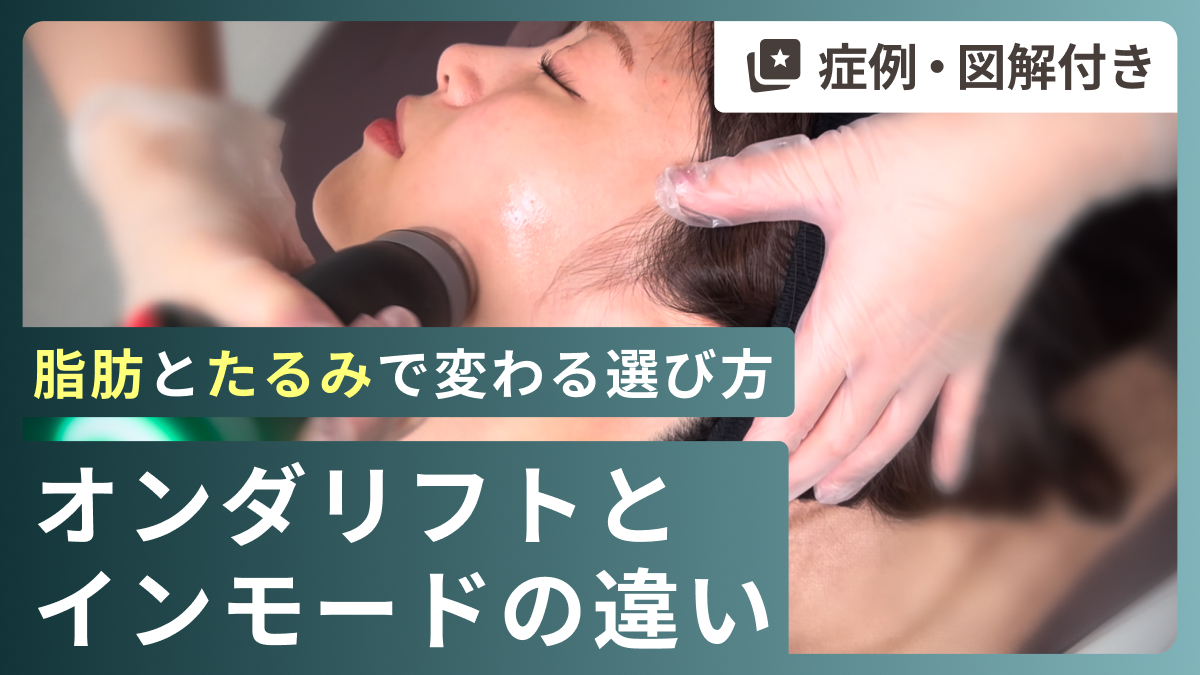
The difference between ONDA Pro and ONDA Lift is what they refer to: the device name versus the treatment name.
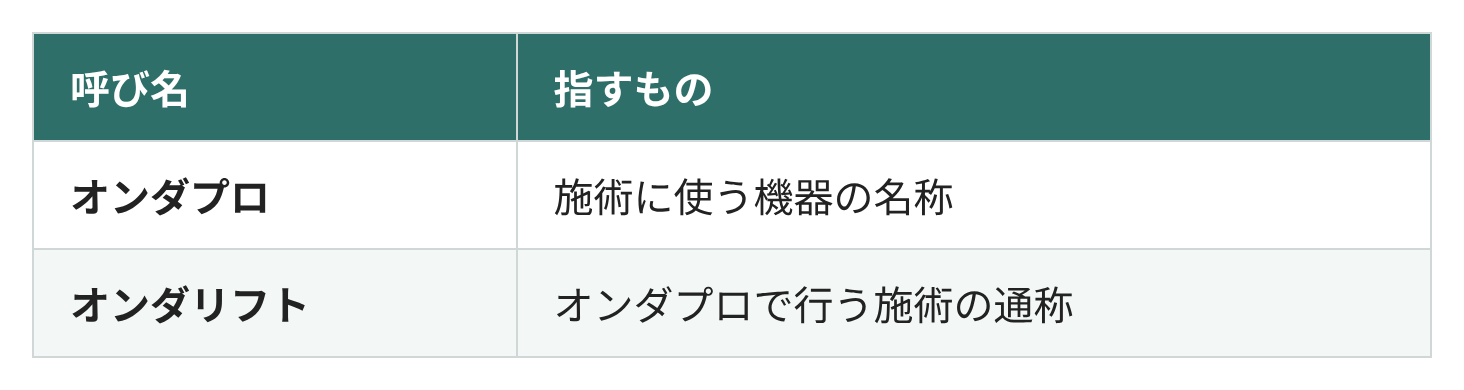
A menu displaying both names can be understood as listing the device name after the treatment name. The items to compare are not the treatment names, but the original ONDA model, the device designation used by each clinic, and the treatment intensity.
ONDA Pro is a microwave medical device developed by DEKA and the latest high-end model in the ONDA series. ONDA is the DEKA brand name for “wave” in Italian. Microwaves are electromagnetic waves that create heat by vibrating water molecules, and the heat reaches from the dermis to the subcutaneous fat layer. ONDA Pro is intended to reduce fat and tighten the skin.
The treatment surface has a cooling function that delivers heat while suppressing increases in the skin’s surface temperature. By switching handpieces, treatment can be adapted to areas ranging from the face to the body.
ONDA Lift is the common name for a treatment that delivers heat to facial or body fat using an ONDA-series device to contour the appearance. It is not the product name of a device, but a name given to the treatment and used on clinic menus.
The common name does not specify the device model. Even when the treatment is called “ONDA Lift,” some clinics use the original ONDA model while others use ONDA Pro, so the model cannot be identified from the menu name alone. The device model must be checked separately.
The two names are used together because each clinic names its menus differently. Some clinics add the device name after the treatment name, as in “ONDA Lift (ONDA Pro),” while others list only the device name, “ONDA Pro,” on the menu.
Some clinics also perform the same “ONDA Lift” treatment using the original ONDA model. Therefore, even when the names are displayed in the same way, they may not refer to the same device. Judging that treatments are the same based only on the names can cause you to overlook differences between the devices.
The difference between the previous ONDA model and ONDA Pro is the addition of the Pocket handpiece, which is designed exclusively for the face. A handpiece is the treatment component placed against the skin, and ONDA Pro has three types.
The original ONDA model does not have the face-only Pocket handpiece. A design specifically targeting the face was added with ONDA Pro. Because ONDA is also the name of the series as a whole, this article refers to the original model as ONDA.
The face-only Pocket handpiece is what ONDA Pro added to the previous ONDA model. On its product page, DEKA explains that it developed Pocket after the introduction of ONDA as a facial design that enables more targeted treatment.
Because Pocket is not available on the previous model, it can be used only at clinics that have introduced ONDA Pro. Some clinics also mention improvements in cooling or treatment control, but the addition identified as a difference on the manufacturer’s product page is Pocket.
ONDA Pro has three types of handpieces, which are selected according to whether the face or body is being treated and the depth of the fat being targeted.
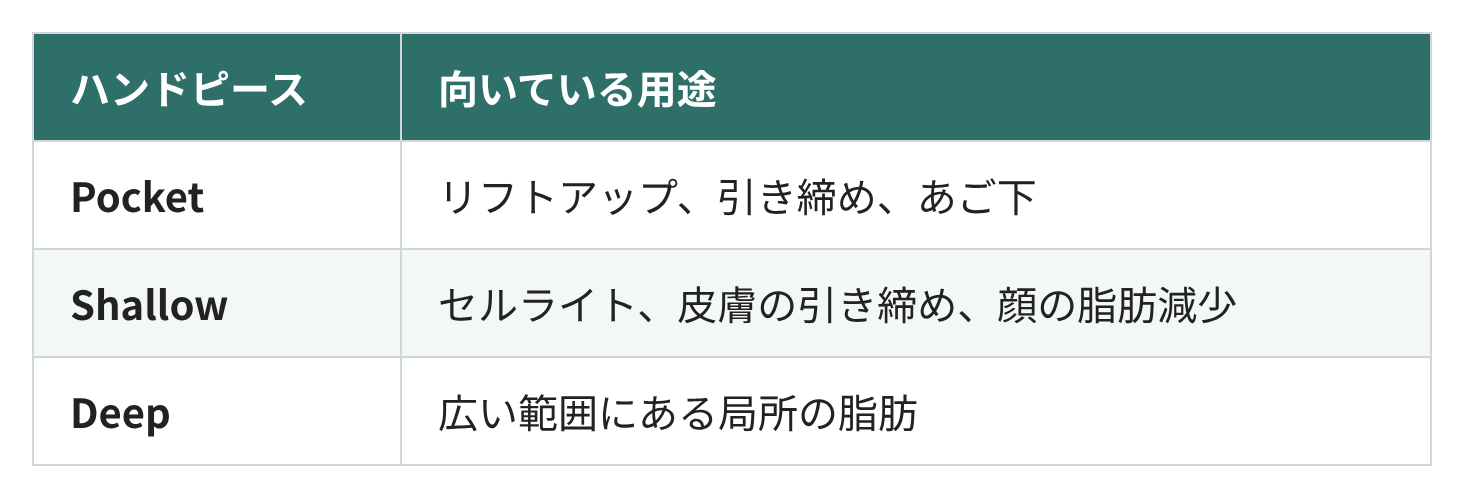
Pocket is designed for facial lifting and tightening, while Deep is designed for localized fat. When targeting fat reduction on the face, some clinics use Shallow.

The expected changes with ONDA Lift are reduced fat in the cheeks and under the chin and a more defined-looking facial contour. Because the heat from microwaves reaches from the dermis to the subcutaneous fat layer, it works on areas that appear bulky or lax.
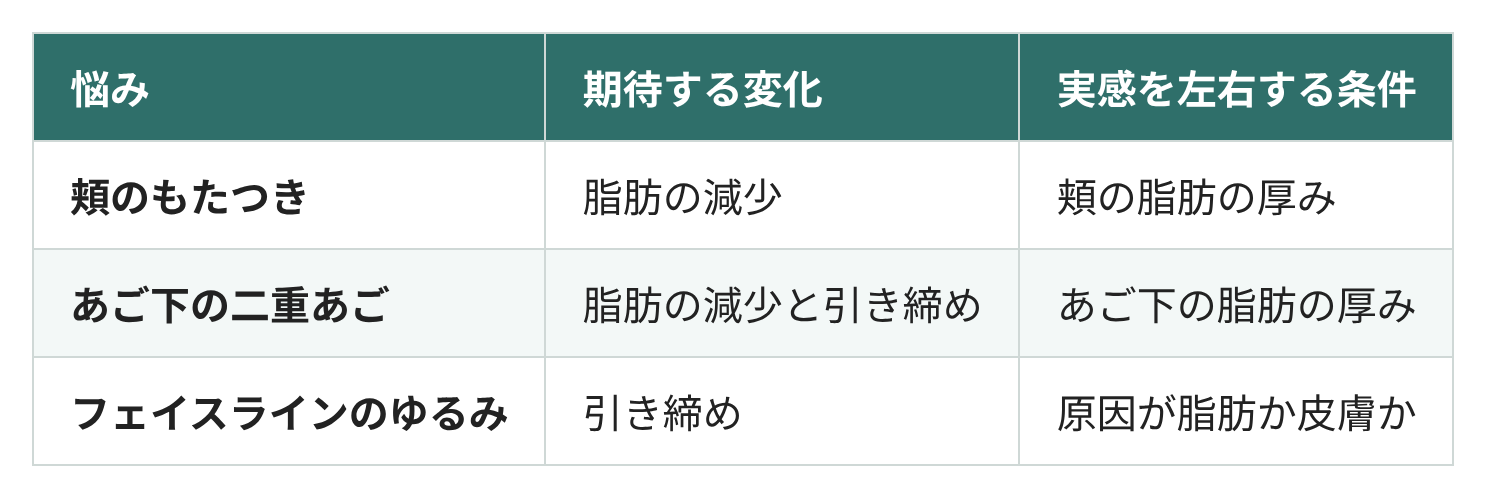
This treatment is considered more likely to produce noticeable changes in people with a greater thickness of fat. On the other hand, whether it is appropriate for laxity mainly caused by bone structure or for laxity with substantial excess skin is determined during a consultation. Results vary from person to person, and changes may not be noticeable. For people with little facial fat, suitability for the treatment is assessed carefully. Whether the primary cause is fat thickness, skin laxity, or bone structure is confirmed during the consultation.
The difference between ONDA Lift and other lifting devices lies in how they generate heat and which layers the heat reaches.
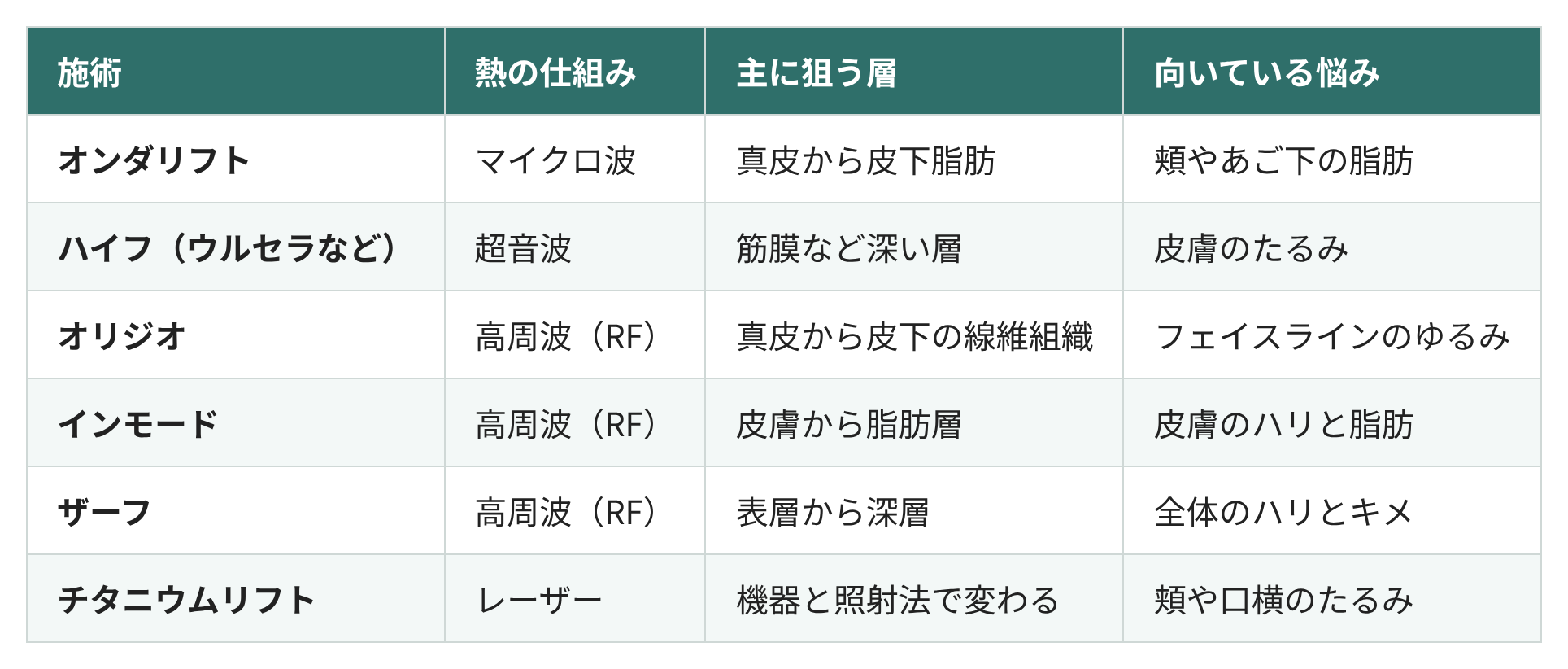
The devices considered may differ depending on whether fat or skin is the primary cause of the concern.
HIFU is a general term for treatments that focus ultrasound at a single point to apply heat, while Ultherapy is one type of HIFU device. It focuses on the fascia (SMAS) beneath the skin and aims to lift with point-like areas of heat.
While ONDA Lift warms an area and delivers heat to the fat layer, HIFU targets the fascia and is suited to concerns primarily caused by skin laxity. Like ONDA Pro, Ultherapy is an unapproved medical device in Japan.
The difference between radiofrequency (RF) and microwaves is how heat is generated. Dermatology explanations describe RF as passing an electrical current to warm fibrous structures through which the current travels easily, while microwaves warm the water-containing fat layer by vibrating water molecules without passing an electrical current.
Oligio is a device that warms the fibrous tissue from the dermis to the subcutaneous layer, while XERF is a device that warms from the superficial to deep layers using two types of frequencies. InMode is characterized by using different applicators for the skin and fat layers.
Titanium Lift is a treatment that simultaneously emits three laser wavelengths and aims to lift laxity around the cheeks, corners of the mouth, and facial contour. It is not a standardized device name, and the details vary depending on the device used and the treatment method.
There is little downtime, but redness or a hot sensation may occur, and some areas may feel a prickling pain. ONDA Lift targets fullness caused by fat in the cheeks and under the chin. As with ONDA Lift, the device cannot be identified from the menu name alone.
The choice between ONDA Lift and other devices depends on whether fat or skin is the primary cause of the concern. ONDA Lift may be considered for fullness caused by fat in the cheeks or under the chin, while HIFU or RF-based treatments may be considered when laxity of the skin itself is the primary concern.
When both fat and laxity are present, combining treatments is another option. At LIVELY CLINIC, we offer “Orionda,” which combines ONDA Lift with Oligio KISS, and “On-Hi,” which combines it with medical HIFU; availability varies by branch.

To identify the device from the menu name, check three points before booking: the device designation, treatment intensity, and handpiece. Because the name ONDA Lift does not specify the device, differences cannot be determined by comparing names alone.
Check the device designation in the “Devices Used” section of the official website. The wording generally falls into two patterns.
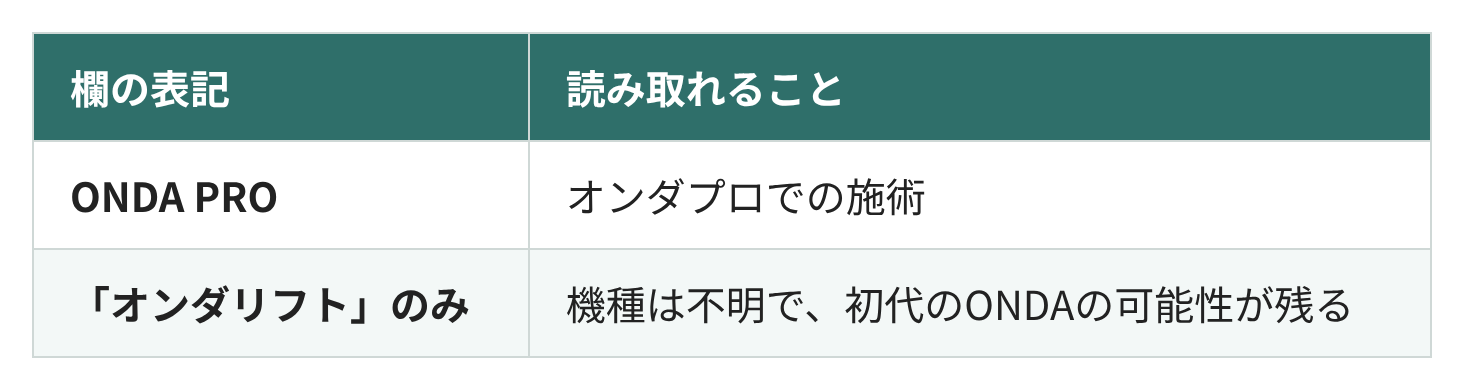
If there is no device section, ask directly about the device name when making an inquiry or during your consultation. LIVELY CLINIC’s menu adds the device name after the treatment name, as in “ONDA Lift (ONDA Pro).”
Even menus for the same area, such as “both cheeks,” may use different treatment intensities from clinic to clinic. Clinics that specify the number of joules, the unit of energy used for treatment, allow you to compare the figures with other clinics. Even at the same price, different treatment intensities or areas mean the treatments cannot be directly compared. However, a larger number is not necessarily better; the appropriate intensity varies according to the area and the thickness of the fat.
When viewing before-and-after photos, check whether the number of treatments and the treatment period are stated in addition to the device name. Photos after one treatment and photos after five treatments cannot be compared on the same basis.
Even when a clinic has introduced ONDA Pro, the handpiece used on the face varies according to the clinic’s treatment design. Ask during your consultation whether the face-only Pocket is used or whether Shallow is used for people with a thicker fat layer; this will help you understand how the treatment is designed.
For example, asking, “Do you use the same handpiece for the cheeks and under the chin?” should clarify whether treatment is designed differently for each area.
The four points to check before treatment are information about the unapproved medical device, pain, downtime, and circumstances in which treatment cannot be performed.
One particularly important point is whether you can receive the explanation about the unapproved medical device in a form that you can review later.
Here are some frequently asked questions about ONDA Pro and ONDA Lift.
ONDA Pro and ONDA Lift are not different treatments. ONDA Pro is the name of the device, while ONDA Lift is the common name for treatment performed with ONDA Pro. However, some clinics perform treatment called “ONDA Lift” using the original ONDA model. Check the device model in the “Devices Used” section of the official website or during your consultation.
It cannot be said from the device specifications alone that ONDA Pro is more effective than ONDA. The difference identified on the manufacturer’s product page is the addition of the face-only Pocket handpiece. If facial contour is the primary concern, it is more accurate to view this as a model offering more treatment options. If localized fat reduction on the body is the main goal, whether a face handpiece is available is not a deciding factor.
The number of ONDA Lift treatments varies according to the area and the amount of fat. It is not a treatment completed in one session; the premise is to undergo multiple sessions while monitoring changes. At LIVELY CLINIC, we recommend continuing treatment about once every two weeks for approximately five sessions, followed by maintenance treatment once every 2–3 months after completing the five sessions. The actual number and intervals are determined after examining the distribution of fat during a consultation.
ONDA Lift is not covered by health insurance. Materials from the Ministry of Health, Labour and Welfare also state that cosmetic medical treatment is generally elective treatment that is not covered by insurance. Because elective treatment fees are set by each medical institution, receive an explanation of the cost before treatment and compare clinics using the same treatment intensity and area.
Some people notice changes after their first ONDA Lift treatment, but LIVELY CLINIC explains that changes appear approximately one month after treatment. The clinic recommends continuing treatment once every two weeks, with changes monitored as the number of sessions increases. The timing varies according to the thickness of the fat and the treatment area, so confirm an approximate timeframe during your consultation.
Many clinics allow face washing, showering, and makeup from the day of treatment. If redness or a hot sensation persists, some clinics advise waiting until the following day or later to take a bath in a tub. Because skin is more susceptible to ultraviolet exposure after treatment, take precautions with sunscreen or a hat. Instructions vary by clinic, so prioritize the written instructions provided after treatment.
ONDA Pro and ONDA Lift are not items to compare; they represent the relationship between a device name and a treatment name. The points to compare are the device model—whether it is the original ONDA or ONDA Pro equipped with the face-only Pocket—and the treatment intensity, which varies by clinic.
As a cosmetic medical clinic offering ONDA Lift, LIVELY CLINIC lists the device used alongside the treatment name. A consultation is the most reliable way to determine whether concerns about the cheeks and under the chin are caused by fat or skin laxity. For people with both fat and laxity, the need for a combination such as Orionda or On-Hi can also be discussed during the consultation.
※Implementation Clinics: Hamamatsucho Clinic
※Implementation Clinics: Hamamatsucho Clinic
※Implementation Clinics: Osaka Clinic, 札幌院
※Implementation Clinics: Osaka Clinic, 札幌院
※Implementation Clinics: Osaka Clinic
※Implementation Clinics: Funabashi Clinic
※Implementation Clinics: Funabashi Clinic
※Implementation Clinics: Osaka Clinic, 札幌院
※Implementation Clinics: Osaka Clinic, 札幌院