


Quantum RF Disadvantages and Precautions | What You Should Know to Avoid Regret

Language:
Language:



BLOG

What makes Quantum RF different from HIFU, Sofwave, and Thread lift? This article compares their mechanisms, effects, downtime, and risks.





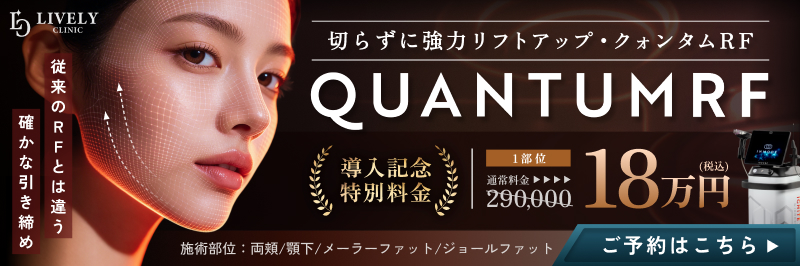


Quantum RF is an aesthetic medical device designed to improve sagging by delivering fractional RF (radiofrequency) to the skin. Some clinics describe it as the “strongest non-surgical sagging treatment,” and interest is growing in it as a treatment that may provide a lifting effect without using a scalpel.
Unlike conventional RF treatments, one of its major features is its selective approach to the tissues responsible for sagging. It is considered capable of aiming for a substantial lifting effect while limiting downtime. It is chosen by people of a wide range of ages who seek to improve facial contour laxity, fullness under the chin, and nasolabial folds.

The fractional RF used by Quantum RF is a technology in which a thin, blunt-tipped cannula is inserted under the skin and RF (radiofrequency) energy is delivered from its tip. The delivered RF energy is converted into heat inside the skin, causing thermal contraction in the target tissue.
Quantum RF specifically targets tissue called the FSN (fibrous septal network). The FSN is a mesh-like structure of collagen fibers that exists from the dermis to the subcutaneous fat layer. When it loosens with age, it appears as sagging and loss of facial contour. Improving this is a strength of fractional RF.
One point that differentiates Quantum RF from other treatments for sagging is its selective approach to the FSN. Conventional RF treatments have mainly used methods that apply heat to the entire dermis, whereas Quantum RF is designed to aim for more efficient lifting by directly targeting the FSN responsible for sagging.
In addition, because the treatment is completed with only the marks from a 2.2-millimeter cannula, it generally involves a shorter downtime and an earlier return to daily activities compared with facelift surgery.
Quantum is suitable for people seeking to improve fullness along the facial contour or nasolabial folds, and for those who are reluctant to undergo incisional surgery but hope for a substantial lifting effect. Because downtime is relatively short, at approximately several days to one week, it is also often chosen by people who have difficulty taking a long vacation from work or other commitments.

The effects that may be expected from Quantum RF treatment are mainly the following three:

It is considered to work in two stages: an immediate tightening effect from thermal contraction of the FSN, followed by a medium- to long-term lifting effect from new collagen production. It tends to be chosen by people seeking to improve fullness along the facial contour, nasolabial folds, and marionette lines. Improved skin firmness and texture may also be expected as secondary effects.

There are various options for treating sagging, and each differs in its areas of strength, downtime, and risks. The main features of these treatments are organized in the table below.
Below, we take a detailed look at the differences between each treatment.
When considering treatment for sagging, HIFU (high-intensity focused ultrasound) is probably the treatment most often compared with other options. Both are popular as “non-surgical treatments for sagging,” but there are clear differences in the energy used and the layers they target. Let us look at the features of each.

Quantum RF uses RF (radiofrequency) energy, whereas HIFU uses ultrasound energy. Because the types of energy differ, the way heat is transmitted and its effects on tissue also differ, representing a fundamental distinction between the two treatments.
RF works by converting electrical energy into heat and applying it to tissue, while HIFU focuses ultrasound at a single point to generate high thermal energy. RF, on the other hand, tends to apply relatively uniform heat over a wider area, whereas HIFU concentrates intense heat at individual points.
A major strength of HIFU is that it can reach the SMAS fascial layer (superficial musculoaponeurotic system), the deepest layer of the skin. The SMAS layer is a membrane-like tissue located above the muscles of facial expression, and it is also the layer targeted for lifting during facelift surgery. HIFU aims to create a lifting effect from deep within by applying heat directly to the SMAS layer.
Quantum RF, on the other hand, is designed to primarily target the FSN, from the deep dermis to the subcutaneous fat layer. Although it does not reach layers as deep as HIFU, it acts on the loosening of the FSN, a direct cause of sagging.
Pain perception varies from person to person, but because HIFU generally applies intense heat to the SMAS layer, the treatment may involve a tingling pain or a sensation that seems to resonate with the bone. It is not unusual for people to feel stronger pain, particularly around the chin or cheekbones.
Quantum RF is not completely painless because a cannula is inserted, but pain can generally be reduced with local anesthesia. Regarding downtime, many people can return to daily activities immediately after HIFU, whereas redness from the needle punctures and mild swelling from Quantum RF may continue for several days.
Sofwave is also a popular device for treating sagging, and more people are considering it in comparison with Quantum RF. Both are “non-surgical treatments for sagging,” but they differ significantly in whether needles are used. Let us review their technical aspects and the direction of their effects.

Sofwave is a device equipped with proprietary ultrasound technology called SUPERB. It delivers 3D ultrasound beams to the mid-dermis, at a depth of approximately 1.5 mm from the skin surface, to promote collagen remodeling (restructuring).
Like HIFU, it is a non-invasive treatment that does not use needles, but the target depth differs. HIFU reaches the SMAS layer, at approximately 4.5 mm, whereas Sofwave is characterized by its focused approach to the mid-dermis. Quantum involves minor invasiveness because a cannula is inserted, but its strength lies in delivering RF energy directly to the FSN.
Because Sofwave primarily acts on collagen in the dermis, its areas of strength include improving skin quality and firmness and reducing fine lines. Although a lifting effect may also be expected, some people may feel that its lifting power is somewhat gentler compared with treatments such as Quantum RF, which directly target the FSN.
On the other hand, Sofwave is characterized by the fact that makeup can be applied immediately after treatment and that it involves relatively little pain. For this reason, it tends to be chosen by people receiving an aesthetic treatment for the first time and those who have difficulty taking time off work for downtime.
Sofwave is generally recommended once every 6–12 months in many cases, and its effects are considered to last approximately six months to one year. Although the details vary depending on the treatment and the degree of sagging, Quantum RF is also commonly recommended as a regular maintenance treatment to maintain its effects.
Neither treatment provides a semipermanent effect from a single session, so it is advisable to consider them with ongoing care in mind.
Thread lift involves inserting medical threads under the skin to physically lift sagging tissue. Its fundamental approach differs from that of Quantum RF, which uses energy to contract tissue. The choice may depend on whether you prioritize immediate results or a short recovery period.

Thread lift involves passing medical threads with cogs (barbs) under the skin to physically lift sagging tissue. Its greatest feature is that a visible lifting effect may be expected immediately after treatment.
Quantum RF gradually produces its effects through thermal contraction caused by RF energy and new collagen production. In some cases, its immediate lifting effect may not be as pronounced as that of Thread lift. However, Quantum RF is completed using only needle punctures, whereas Thread lift uses needles or cannulas to insert the threads and is therefore somewhat more invasive.
Downtime tends to be longer for Thread lift than for Quantum RF. Swelling and bruising at the thread insertion sites may continue for approximately 1–2 weeks, and the period during which opening the mouth wide or making pronounced facial expressions feels uncomfortable must also be considered.
Risks specific to Thread lift include visible threads, a pulling or tight sensation, asymmetry, and infection. Quantum RF also carries risks such as burns and hyperpigmentation, but its risk factors for complications differ in nature from those of Thread lift, which physically inserts a foreign material.
You do not necessarily have to choose between Quantum RF and Thread lift. Some clinics propose combination plans in which Quantum RF promotes tightening of the FSN and new collagen production, while Thread lift provides a physical lifting effect.
When sagging is moderate or more severe, combining multiple treatments may produce greater effects in some cases. It is advisable to consult with a doctor and consider the most suitable plan.
Facelift surgery has the longest history as a surgical method for improving sagging and also provides substantial effects. There are clear differences in the magnitude of the effects and downtime between facelift surgery and non-surgical treatments such as Quantum RF. Before considering surgery, understand how it differs from non-surgical treatments.

Facelift surgery is a surgical method that fundamentally improves sagging by making incisions in front of or behind the ears, removing excess skin, and lifting the SMAS layer. Its effects are the most substantial, and its duration of approximately 5–10 years is a long-term benefit not offered by non-surgical treatments.
Quantum RF, on the other hand, cannot be expected to produce as dramatic a change as facelift surgery. When sagging is severe, it is necessary to consider that non-surgical treatments alone have limitations.
Facelift surgery is performed under general anesthesia or local anesthesia with sedation, and downtime lasts approximately 2–4 weeks. After surgery, compression with bandages or a facial band is required, and patients must allow time for follow-up visits until suture removal and for swelling and bruising to recover. There is also a risk of scarring, so the psychological and physical burden is considerable.
With Quantum RF, downtime is approximately several days to one week, and the impact on daily life is substantially reduced compared with surgery. For people who are not ready to undergo surgery or cannot take an extended period of downtime, it may be a practical option.


There are points you should understand in advance when considering Quantum RF. Specifically, these include the following:
Be sure to confirm the following before receiving treatment, from the perspectives of expected effects, risks, and choosing a clinic.
This does not apply only to Quantum RF, but it is important to understand that the effects of aesthetic medical treatments vary from person to person. Multiple factors, including the degree of sagging, age, skin condition, and lifestyle, influence the results, so even people receiving the same treatment may experience different outcomes.
You may come across phrases such as “the strongest non-surgical sagging treatment,” but excessive expectations should be avoided. Make your decision after hearing a realistic outlook from the doctor during your consultation.
People who are pregnant or breastfeeding, those with metal such as plates or implants in the treatment area, and those using a pacemaker are generally unable to receive Quantum RF treatment. Treatment may also be postponed for people with inflammation or an infection in the treatment area and those prone to keloids.
If you have an underlying medical condition or are taking medication, be sure to inform the doctor during your consultation. It is important not to make this decision yourself and to seek a professional’s judgment.
In Japan, Quantum RF is classified as an unapproved medical device that has not received approval under the PMD Act (the Pharmaceuticals and Medical Devices Act). Although being unapproved does not in itself immediately mean that the device is dangerous, you should be aware that it has not undergone review in Japan.
Because many clinics perform the treatment based on clinical experience overseas, obtain a thorough explanation of the device from the clinic before treatment and make your decision only after you are satisfied with the information provided.
The effects of Quantum RF are considered to depend heavily on the practitioner’s skill and experience. Clinics that publish before-and-after photographs and treatment records may provide useful information for making a decision. You should also check whether a specialist in plastic surgery or cosmetic surgery performs the treatment.
We recommend checking the following points:
A clinic that carefully explains not only the benefits but also the risks and limitations during the consultation can be considered reassuring in terms of reliability.
At LIVELY CLINIC, we have an aftercare system in place. If you have any concerns after treatment or notice any unusual changes, even minor ones, we provide examinations free of charge. Please do not hesitate to contact us.
Quantum RF is a non-surgical treatment for sagging that uses fractional RF to target the FSN (fibrous septa). Compared with other options, such as HIFU, Sofwave, Thread lift, and facelift surgery, each has different areas of strength, downtime, and risks.
There is no single correct answer to the question, “Which treatment is best?” It is important to consider the cause and severity of sagging, the degree of results you hope to achieve, and the amount of downtime you can accept, then choose a treatment suited to you after consulting with a doctor.
※Implementation Clinics: Osaka Clinic
※Implementation Clinics: Osaka Clinic
※Implementation Clinics: Osaka Clinic
※Implementation Clinics: Osaka Clinic
※Implementation Clinics: Osaka Clinic
*Basic set (consumables, local anesthetic, oral medication) ¥110,000
Compression band (face) ¥5,500
Compression band (body) ¥16,500


