
Achieve Firmer, Youthful-Looking Skin with Volnewmer (Radiofrequency): Treatment Areas Explained

Language:
Language:



BLOG
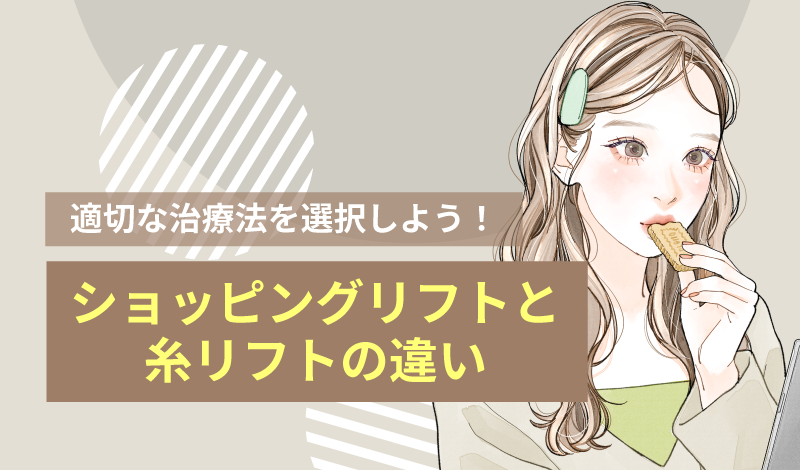
Many people are concerned about sagging skin and a loss of definition along the face due to aging and gravity. Shopping Lift and Thread Lift have attracted attention as treatments for these concerns.
However, these two treatments have clear differences. To choose the procedure that is right for you, it is important to understand the characteristics of each one.
This article explains the differences between Shopping Lift and Thread Lift in detail from six perspectives. It also covers the advantages, disadvantages, and treatment process for each. Use this information as a reference when choosing the treatment that is best suited to you.








Shopping Lift is a cosmetic procedure used to improve sagging skin. It uses dissolvable medical threads, so thread removal is not necessary. In addition, because it promotes collagen production, it is considered to improve skin firmness and elasticity along with its lifting effect.
During the procedure, very fine threads are inserted into the superficial layers of the skin, making scars inconspicuous and allowing for relatively short downtime. Adjusting the number of threads can provide results tailored to each person’s wishes. It is considered particularly suitable for people seeking to firm the entire face or improve fine lines.
Furthermore, because it is a nonsurgical treatment that does not use a scalpel, it is popular as a convenient lifting procedure to try.
Thread Lift is a cosmetic procedure in which specialized threads are inserted into the subcutaneous tissue to physically lift sagging skin and improve the definition of the face and skin laxity. Unlike Shopping Lift, the threads used have projections called “cogs” or “barbs.” These firmly anchor the threads to the skin and fascia, allowing for a potentially significant lifting effect.
Another feature is that the inserted threads may promote collagen production as they are absorbed by the body. In addition to the lifting effect, improvements in skin firmness and texture may also be achieved.
Thread Lift generally has a relatively long-lasting effect, typically lasting from six months to more than one year, although results vary from person to person. On the other hand, the procedure is more technically demanding than Shopping Lift, and anesthesia may be required.
Although both procedures use threads, they differ in the following six ways.
Even though the procedures may appear similar, they have the differences described above. Let’s take a closer look at each one.
One of the major differences between Shopping Lift and Thread Lift is the type and number of threads used. In Shopping Lift, several dozen ultra-fine, smooth threads are inserted. By inserting many threads into the superficial layers of the skin, the procedure aims to promote collagen production and improve skin firmness and fine lines.
In contrast, many of the threads used for Thread Lift have projections or barbs called “cogs,” which catch firmly onto the tissue to create a lifting effect. Threads with greater durability may also be used. Thread Lift generally uses fewer threads than Shopping Lift to enhance the effect.
The choice and number of threads are determined by the practitioner based on the patient’s skin condition and desired results. However, it is generally helpful to remember that different types of threads are used.
The length of downtime also differs. Because Shopping Lift uses ultra-fine threads inserted into the superficial layers, swelling and bruising are less likely to occur, and the downtime is short, usually resolving within one week even when present.
In contrast, Thread Lift involves inserting threads into the deeper layers of the skin, making swelling and bruising more likely. Downtime may last approximately one to two weeks. A feeling of discomfort or tightness may also occur after treatment, so it is important to plan your schedule with sufficient time for recovery.
For both procedures, avoid applying makeup immediately afterward. Since this can increase the risk of infection, wait until the treated area has settled before applying makeup.
The duration of results also differs between Shopping Lift and Thread Lift. Shopping Lift is primarily intended to improve skin firmness and fine lines, and provides a natural lifting effect through collagen production. However, the results last for a relatively short period of approximately 6–12 months, so regular treatments are necessary.
In contrast, Thread Lift physically lifts the skin, making it more immediately effective and suitable for lifting the entire face and improving sagging. The results typically last approximately 12 months to one and a half years, which is relatively long. However, please note that this varies depending on the type and number of threads used.

Shopping Lift and Thread Lift differ in the areas they are suited to treat. Shopping Lift is suitable for areas addressed through the superficial layers of the skin, such as around the eyes, nasolabial folds, forehead, and areas where fine lines are a concern. It is particularly effective for improving overall skin firmness and mild sagging.
Thread Lift is suitable for areas requiring an approach to the deeper layers of the skin or the fascia (SMAS layer), such as the cheeks, face line, chin, and neck. It is particularly recommended for improving moderate to severe sagging.
The insertion sites and use of anesthesia also differ. In Shopping Lift, ultra-fine threads are inserted into the superficial layers of the skin, such as the dermis and subcutaneous tissue. Therefore, although mild pain may occur, the procedure can often be performed without anesthesia or with topical anesthesia only.
For Thread Lift, threads are inserted into the deeper layers of the skin or the fascia (SMAS layer), so local anesthesia and, in some cases, intravenous anesthesia are required. If the treatment area is extensive, the type or amount of anesthesia may also increase.
One of the main features of Shopping Lift is its limited impact on daily life. Although mild swelling or bruising may occur, it settles within one week, allowing you to quickly resume makeup application and normal activities. This makes it a procedure that can be readily received even by people with busy schedules.
In contrast, swelling and bruising are relatively more likely with Thread Lift, and a feeling of discomfort or tightness may be experienced for approximately one week after treatment. If you have important plans coming up, you will need to adjust your schedule.
Shopping Lift is appealing because of its convenience and short downtime. Its main advantages include the use of ultra-fine dissolvable threads, which make scars inconspicuous, while mild swelling and bruising generally resolve within one week.
In addition, the treatment may improve skin firmness and fine lines by promoting collagen production. Another advantage is that treatment is possible without anesthesia or with topical anesthesia only.
On the other hand, one disadvantage is that regular treatments are necessary because the results last for a relatively short period of approximately 6–12 months. In addition, because it works on the superficial layers of the skin, the effect may be insufficient when moderate or more severe sagging or a significant lifting effect needs to be addressed.
Shopping Lift is suitable for people seeking a mild lifting effect or improved skin texture. However, if you aim to improve deep sagging, combining it with other treatments should also be considered.
Thread Lift is characterized by a significant lifting effect and durability. Its main advantage is its immediate effectiveness: specialized threads with projecting cogs are used to physically lift sagging skin and the fascia (SMAS layer).
As the threads are absorbed by the body, they may also promote collagen production, potentially improving skin firmness and texture. The relatively long duration of results—approximately 12 months to one and a half years or longer—is another appealing feature.
On the other hand, a disadvantage is that local or intravenous anesthesia may be required during the procedure. Swelling and bruising are more likely than with Shopping Lift, and downtime may last more than one week. In some cases, a feeling of tightness or discomfort may continue after treatment, so it is important to have the procedure performed by a trusted physician.
Thread Lift is suitable for people who want to improve moderate to severe sagging or firmly define the contours of the face.
The treatment process differs between Shopping Lift and Thread Lift. Understanding the details of each can help you decide which procedure is right for you.
Shopping Lift is performed as follows.
1. Consultation and examination: The physician assesses the patient’s wishes and skin condition and determines the appropriate number of threads and insertion sites
2. Preparation: Makeup and impurities are removed, and the treatment area is cleansed
3. Marking: The insertion sites are marked to clarify the placement of the threads
4. Thread insertion: Specialized ultra-fine needles are used to insert the threads into the superficial layers of the skin
5. Post-treatment check: The insertion of the threads and the results are checked, completing the procedure
6. Aftercare instructions: Precautions for reducing downtime are explained
Anesthesia is generally not necessary, although topical anesthesia may be administered in some cases. Although downtime is relatively short, listen carefully to the instructions for minimizing it.
The Thread Lift procedure is performed as follows.
1. Consultation and examination: The degree of sagging and desired results are assessed, and the appropriate number of threads and other details are determined
2. Preparation: Makeup and impurities are completely removed, the treatment area is disinfected, and local or intravenous anesthesia is administered
3. Marking: The skin is marked to clarify the direction and position of the threads to be inserted
4. Thread insertion: Threads with cogs are inserted using specialized needles or cannulas
5. Final check: The lifting effect is checked, and any excess thread is cut to complete the procedure
6. Postoperative care instructions: Precautions for reducing swelling and bruising, as well as points to keep in mind in daily life, are explained
Swelling and bruising may continue for approximately one week after Thread Lift. Avoid strenuous exercise and exaggerated facial movements for several days after treatment, and rest until the threads have stabilized. Consult the clinic promptly if you notice any concerning symptoms.

Shopping Lift is recommended for people concerned about mild sagging or fine lines, or those who want to conveniently improve skin firmness with a short downtime. It is also suitable for people who prioritize natural-looking results and want to try a cosmetic procedure for the first time.
However, its effect may be limited when improving moderate or more severe sagging is the goal, so combining it with other treatments is recommended.
Thread Lift is suitable for people who want to improve moderate to severe sagging or firmly define the contours of the face. It is also recommended for those who prioritize immediate and long-lasting results. In particular, it is suitable for people concerned about age-related sagging in the cheeks or around the chin, or those seeking a significant lifting effect.
Shopping Lift and Thread Lift are both cosmetic procedures intended to improve sagging and provide a lifting effect, but their characteristics and suitable applications differ. It is important to understand the advantages and disadvantages of each before making a choice.
In particular, consultation with a trusted physician is essential when choosing a procedure that suits your daily life and desired results. Select the appropriate treatment according to your skin condition and concerns.
*Please note that we are currently not carrying Jenba yarn.